2029 Weekly Payroll Calendar: Complete 52-Period Schedule & Hourly Administration Guide
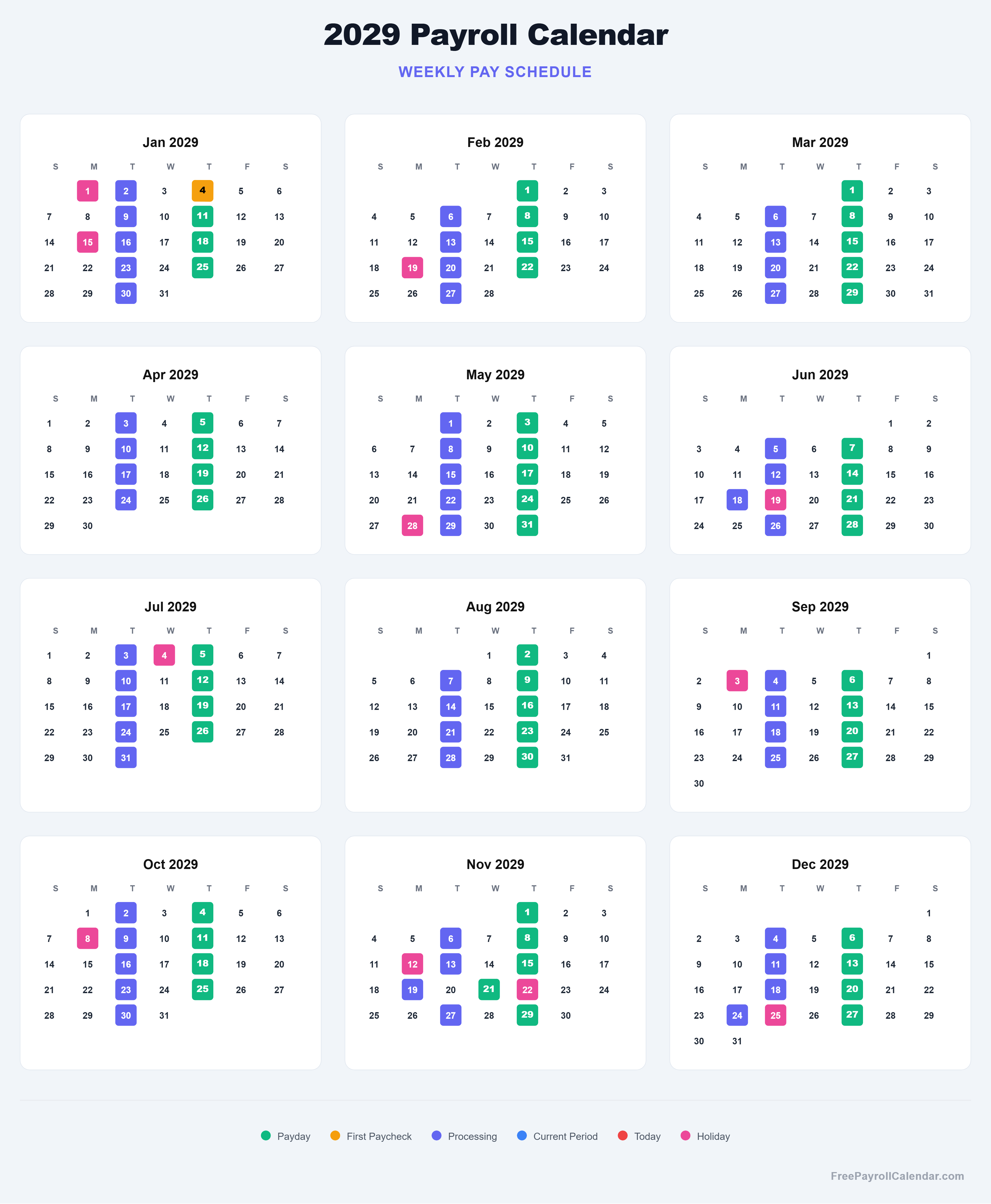
In dynamic, fast-paced industries such as commercial construction, hospitality, logistics, healthcare staffing, manufacturing, and food service, weekly payroll remains the operational gold standard. Under the 2029 weekly payroll calendar, workers receive exactly 52 paychecks. The annual disbursement cycle initiates on Friday, January 5, 2029 (covering work performed from December 23 through December 29, 2028 under standard 7-day payroll lag agreements) and concludes on Friday, December 28, 2029.Compare payroll cadences with the salaried 2029 biweekly payroll calendar or the corporate 2029 semi-monthly payroll calendar. You can also review prior schedules on the 2028 weekly payroll calendar or plan upcoming long-term cycles on the 2030 weekly payroll calendar.
Calendar Mathematics Behind the 2029 Weekly Pay Schedule
2029 represents a clean, standard payroll operating year. A standard Gregorian calendar year contains 365 days, which equals 52 weeks plus 1 surplus calendar day. Because 2029 begins on a Monday (January 1, 2029) and concludes on a Monday (December 31, 2029):
- 2029 contains 53 Mondays, but exactly 52 Fridays.
- Because commercial weekly payrolls overwhelmingly disburse on Friday mornings, employers will execute precisely 52 weekly payroll runs during the 2029 calendar year.
- Unlike 2027 (which contained 53 Fridays), 2029 requires no complex 53-paycheck salary recalibration, no deduction holidays, and no adjustment to standard annual salary formulas.
Gross Pay Calculations: Hourly vs. Salaried Employees in 2029
Administering payroll across 52 weekly cycles requires precise mathematical calculations depending on employee wage classifications:
1. Salaried Exempt Employees
For salaried employees whose compensation is defined by an annual contract figure, weekly gross pay is calculated by dividing total annual salary by 52:
- $65,000 Annual Salary: $65,000 ÷ 52 = $1,250.00 gross per week.
- $80,000 Annual Salary: $80,000 ÷ 52 = $1,538.46 gross per week.
- $104,000 Annual Salary: $104,000 ÷ 52 = $2,000.00 gross per week.
2. Hourly Non-Exempt Employees
Hourly employees are compensated for actual hours clocked during the 7-day period. Under standard FLSA rules:
- Regular Wages: Regular Hours (up to 40) × Regular Hourly Rate.
- Overtime Wages: Overtime Hours (hours in excess of 40 in a workweek) × (1.5 × Regular Hourly Rate).
- Example: An employee earning $24.00 per hour who logs 46 hours receives: (40 × $24.00) + (6 × $36.00) = $960.00 + $216.00 = $1,176.00 gross.
FLSA Overtime Compliance: Why Weekly Pay Eliminates Audit Exposure
Under Section 7(a) of the federal Fair Labor Standards Act (FLSA) (29 U.S.C. § 207), covered non-exempt employees must receive overtime compensation at not less than 1.5 times their regular hourly rate for all hours worked over 40 in a designated workweek.
The statutory workweek is strictly defined as seven consecutive 24-hour periods (168 consecutive hours). Weekly payroll is universally recognized by labor auditors as the cleanest payroll structure for FLSA compliance because:
- 1:1 Pay Period Synchronization: Every single weekly pay period exactly mirrors one statutory 7-day workweek. Employers never have to divide or prorate a workweek across two different paychecks.
- Elimination of Split-Workweek Liabilities: In semi-monthly payroll systems, the 15th and last day of each month cut directly through workweeks, forcing payroll software to perform complex split-week allocations. If an employee logs 30 hours before the 15th and 20 hours after the 15th in the same workweek, semi-monthly software frequently fails to recognize that 10 hours of statutory overtime are owed, creating substantial legal liability. Weekly payroll prevents this vulnerability entirely.
- Instantaneous Error Discovery: Missing punches, unapproved overtime, and shift differential disputes are caught and corrected every seven days, ensuring complete employee trust.
State Wage Payment Mandates: Mandatory Weekly Pay for Manual Workers
In multiple states, weekly pay is not simply a business choice—it is a strict statutory requirement enforced with harsh penalties:
- New York Labor Law § 191(1)(a): Strictly requires that manual workers be paid weekly, no later than seven calendar days after the end of the workweek in which the wages were earned. The New York Department of Labor interprets "manual worker" very broadly to include warehouse personnel, machine operators, mechanics, line technicians, delivery drivers, and retail stockers. Employers paying manual workers biweekly or semi-monthly face mandatory liquidated damages equal to 100% of delayed wages under established New York case law.
- Massachusetts General Laws ch. 149, § 148: Directs employers to pay hourly workers weekly (or biweekly within 6 to 7 days of period end), enforcing mandatory treble damages and attorney fees for non-compliance.
- Connecticut General Statutes § 31-71b: Designates weekly payroll as the default statutory frequency for non-exempt workers unless granted an explicit regulatory waiver.
Four Months with 5 Weekly Paychecks in 2029
Because 52 weekly paydays are distributed across 12 calendar months, four months in 2029 contain five Friday paydays instead of four:
- March 2029: 5 Paychecks (Mar 2, Mar 9, Mar 16, Mar 23, Mar 30).
- June 2029: 5 Paychecks (Jun 1, Jun 8, Jun 15, Jun 22, Jun 29).
- August 2029: 5 Paychecks (Aug 3, Aug 10, Aug 17, Aug 24, Aug 31).
- November 2029: 5 Paychecks (Nov 2, Nov 9, Nov 16, Nov 23, Nov 30).
For hourly employees living on strict household budgets, these four "magic months" deliver substantial financial breathing room. Because major monthly fixed expenses (rent, mortgage, auto insurance) are typically covered by the first 4 paychecks, the 5th check provides unencumbered disposable income for savings or emergency repairs.
Operational Comparison Matrix: Weekly vs. Biweekly vs. Semi-Monthly
| Operational Attribute | Weekly (52 Checks) | Biweekly (26 Checks) | Semi-Monthly (24 Checks) |
|---|---|---|---|
| Disbursements in 2029 | 52 Paychecks | 26 Paychecks | 24 Paychecks |
| $78,000 Annual Gross / Check | $1,500.00 gross | $3,000.00 gross | $3,250.00 gross |
| FLSA Overtime Tracking | 100% Direct Match (7-day workweek) | Two 7-day cycles per period | Split workweeks require proration |
| ACH & Software Cost | Highest (52 submissions/year) | Moderate (26 submissions/year) | Lowest (24 submissions/year) |
| Employee Retention Advantage | Superior for hourly & blue-collar | Standard corporate expectation | Preferred by executive management |
2029 Federal Reserve Bank Holidays & ACH Transmission Deadlines
Managing 52 weekly payrolls requires continuous tracking of Federal Reserve banking closures under National Automated Clearing House Association (NACHA) guidelines:
- New Year's Day (Monday, January 1, 2029): Commercial banks closed. Files for the Friday, January 5 payday must be originated by Tuesday, January 2.
- Martin Luther King Jr. Day (Monday, January 15, 2029): Federal Reserve closed. Submit ACH files for the January 19 payday by Tuesday, January 16.
- Presidents' Day / Washington's Birthday (Monday, February 19, 2029): Banks closed. Transmit direct deposit files for February 23 by Tuesday, February 20.
- Memorial Day (Monday, May 28, 2029): Federal Reserve closed. Submit files for the Friday, June 1 payday by Tuesday, May 29.
- Juneteenth National Independence Day (Tuesday, June 19, 2029): Federal Reserve closed mid-week. Files for the Friday, June 22 payday must be transmitted by Monday, June 18.
- Independence Day (Wednesday, July 4, 2029): Banks closed. Submit files for the Friday, July 6 payday by Monday, July 2.
- Labor Day (Monday, September 3, 2029): Banks closed. Transmit direct deposit files for Friday, September 7 by Tuesday, September 4.
- Columbus Day / Indigenous Peoples' Day (Monday, October 8, 2029): Federal Reserve closed. Submit files for October 12 payday by Tuesday, October 9.
- Veterans Day (Observed Monday, November 12, 2029): November 11 falls on Sunday; Federal Reserve observes on Monday, November 12. Submit files for Friday, November 16 by Tuesday, November 13.
- Thanksgiving Day (Thursday, November 22, 2029): Banks closed nationwide. Direct deposit batches for Friday, November 23 must be transmitted by Tuesday, November 20 at 5:00 PM EST.
- Christmas Day (Tuesday, December 25, 2029): Commercial banks closed. Transmit payroll files for the final annual payday (Friday, December 28) by Monday, December 24.