2029 Monthly Payroll Calendar: Complete 12-Period Schedule & Corporate Compensation Guide
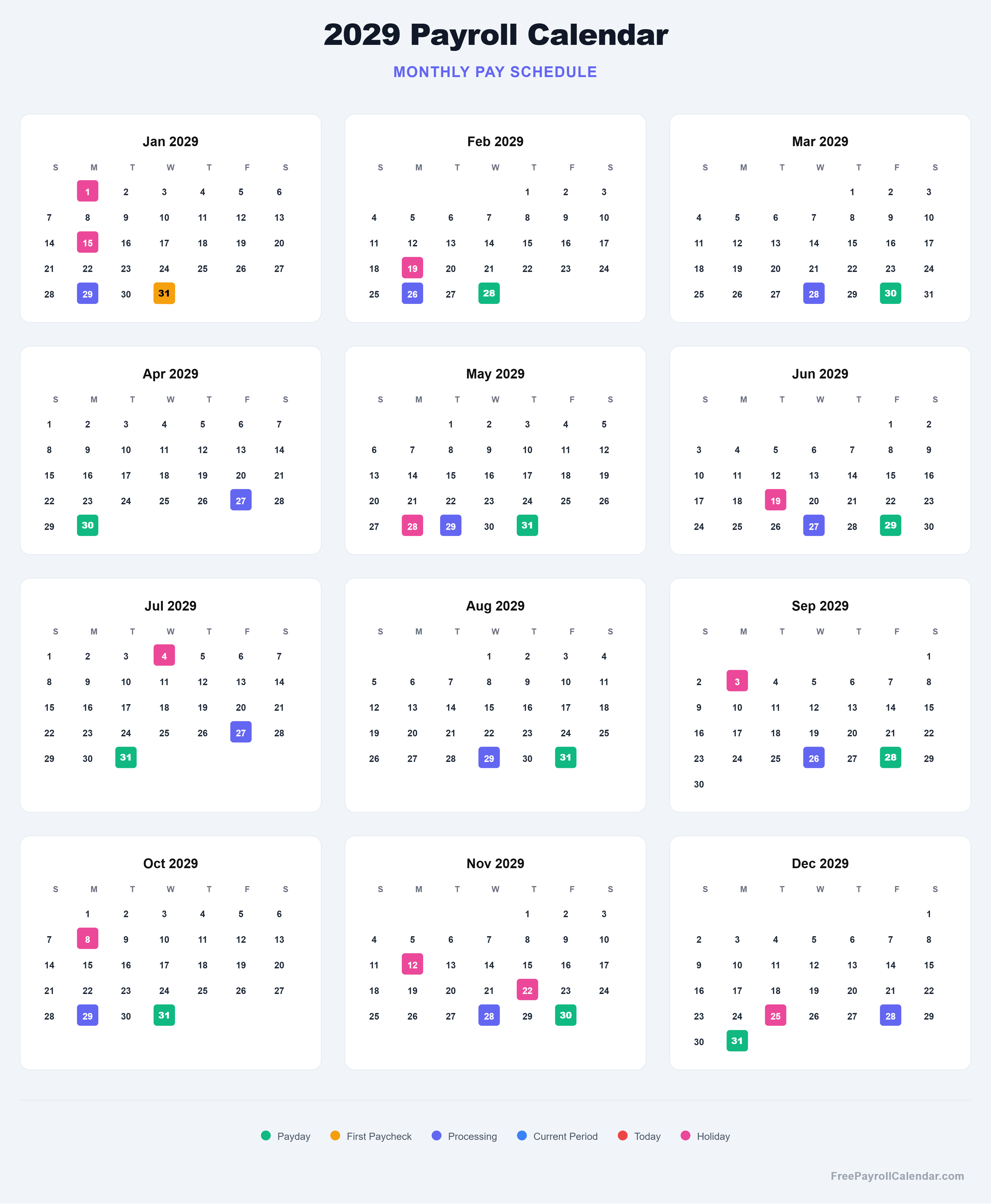
For enterprise controllers, university financial officers, non-profit directors, and executive compensation administrators, the 2029 monthly payroll calendar offers the lowest administrative overhead and cleanest general ledger reconciliation of any compensation structure. Operating on a monthly frequency delivers exactly 12 paychecks per year, disbursed on the final business day of each calendar month. The 2029 monthly payroll cycle commences on Wednesday, January 31, 2029 (an open banking day requiring zero adjustments) and concludes on Monday, December 31, 2029 (also an open banking business day).Compare operational workflows with the 2029 semi-monthly payroll calendar or the popular 2029 biweekly payroll calendar. You can also review prior monthly schedules on our 2028 monthly payroll calendar or prepare long-term projections with our 2030 monthly payroll calendar.
Calendar Symmetry: Why 2029 Has Clean Bookends
One of the most notable administrative characteristics of 2029 is its calendar bookend symmetry. In many calendar years, either January 31 or December 31 lands on a Saturday or Sunday, forcing payroll departments to accelerate disbursement into the preceding business week. In 2029, however:
- Period #1 (January): Concludes on Wednesday, January 31, 2029. With Martin Luther King Jr. Day falling comfortably early on Monday, January 15, ACH originations follow standard 2-day batch timing without mid-week compression.
- Period #12 (December): Concludes on Monday, December 31, 2029. Despite Christmas falling on Tuesday, December 25, 2029, direct deposits clear directly on New Year's Eve, ensuring all twelve 2029 compensation disbursements clear within the exact 2029 tax year boundary.
- 261 Working Weekdays: Full-time personnel in 2029 observe 261 standard working weekdays (Monday through Friday), translating to 2,088 standard working hours. Exempt salaried staff receive their fixed monthly stipend regardless of whether individual months contain 20, 21, 22, or 23 working weekdays.
The "Last Business Day" Rule & 2029 Weekend Rollbacks
Under National Automated Clearing House Association (NACHA) operating rules, payroll direct deposits must be credited to employee financial institution accounts on or before the contractual payday. If the final calendar day of a month lands on a weekend or federal banking holiday, the disbursement date rolls back to the closest preceding business day. In 2029, exactly three months require a weekend rollback:
- March 2029 Rollback (1 Day Earlier): March 31 lands on a Saturday. Funds are credited on Friday, March 30, 2029. ACH files must be transmitted by Wednesday, March 28.
- June 2029 Rollback (1 Day Earlier): June 30 lands on a Saturday. Direct deposits settle on Friday, June 29, 2029. Note that Juneteenth occurs on Tuesday, June 19, leaving late June processing unimpeded.
- September 2029 Rollback (2 Days Earlier): September 30 lands on a Sunday. Payday rolls back two full days to Friday, September 28, 2029. ACH transmission must be completed by Wednesday, September 26.
- Clean Weekday Paydays: The remaining nine months of 2029 conclude on standard weekdays (Monday through Friday) and require zero date acceleration.
State Wage Payment Restrictions: Mandatory Minimum Frequencies
While monthly payroll is extraordinarily popular among corporate finance departments due to low transaction costs, state labor departments enforce strict statutory minimum pay frequencies to protect worker cash flow:
- California (Labor Code § 204): Strictly mandates that all non-exempt employees be paid at least semi-monthly. Monthly payroll is legal only for executive, administrative, and professional employees exempt under California Industrial Welfare Commission (IWC) Wage Orders, or licensed physicians and surgeons.
- New York (Labor Law § 191): Manual workers must be paid weekly within seven days of the end of the workweek. Non-exempt clerical and other workers must receive pay at least semi-monthly. Monthly payroll is restricted exclusively to bona fide exempt white-collar executives earning above the statutory salary threshold.
- Texas (Labor Code § 61.011): Establishes that employees subject to the overtime provisions of the federal Fair Labor Standards Act (FLSA) must be paid at least twice per month. Monthly payroll is lawful only for employees exempt from FLSA overtime regulations.
- Illinois (820 ILCS 115/3): Requires non-exempt workers to receive compensation semi-monthly or biweekly. Employers may only designate monthly pay for exempt executive, administrative, or professional personnel.
Gross Pay Mathematics: The Accounting Simplicity of Dividing by 12
For enterprise accounting departments, monthly payroll eliminates multi-period reconciliation headaches under US GAAP:
- General Ledger Synchronization: Each monthly payroll matches exactly one accounting period and one calendar month. There are zero split-month journal entries, zero mid-month accruals, and zero balance sheet distortions.
- Salaried Formula: Gross pay per paycheck equals `Annual Contract Salary ÷ 12`:
- $96,000 Annual Salary: $96,000 ÷ 12 = $8,000.00 gross per month.
- $120,000 Annual Salary: $120,000 ÷ 12 = $10,000.00 gross per month.
- $150,000 Annual Salary: $150,000 ÷ 12 = $12,500.00 gross per month.
- Fixed Benefit Deductions: Employee contributions for health, dental, vision, life insurance, and commuter benefits are deducted in 12 equal monthly installments, aligning 1:1 with monthly premium billings from insurance providers.
FLSA Overtime Hazards: Why Monthly Pay Fails for Non-Exempt Staff
Under Section 7(a) of the federal Fair Labor Standards Act (FLSA) (29 U.S.C. § 207), statutory overtime must be evaluated across an established, regularly recurring workweek consisting of seven consecutive 24-hour periods (168 consecutive hours). Non-exempt employees who work over 40 hours in that workweek must receive 1.5× their regular hourly rate.
Attempting to apply monthly pay to hourly or non-exempt employees creates severe legal vulnerabilities:
- Split-Workweek Complexity: A calendar month contains 28 to 31 days. Month-end dates cut directly through standard 7-day workweeks. If an employee works 30 hours in the final days of April and 18 hours in the first days of May within the same workweek, tracking whether the 40-hour overtime threshold was crossed requires complex cross-month proration.
- Statutory Late Payment Penalties: Federal and state prompt-payment statutes generally require overtime to be disbursed within the pay period immediately following the period in which it was earned. Delaying overtime pay for up to 30 days can trigger substantial liquidated damages during Department of Labor audits.
Institutional Settings: Academia, Public Sector & Executive Suites
Because of legal constraints and cash-flow characteristics, monthly payroll is concentrated in specialized institutional environments:
- Higher Education: University professors, academic department chairs, and research fellows operating on 9-month or 12-month tenure contracts.
- Government & Public Sector: Municipal department directors, state agency commissioners, judges, and elected officials.
- Corporate C-Suites & Directors: Senior executives, corporate officers, and board members receiving monthly governance retainers.
- Pensions & Annuities: Corporate defined-benefit retirement distributions, executive non-qualified deferred compensation (NQDC) plans, and structured severance payments.
Operational Frequency Matrix: Monthly vs. Semi-Monthly vs. Biweekly
| Key Attribute | Monthly (12 Checks) | Semi-Monthly (24 Checks) | Biweekly (26 Checks) |
|---|---|---|---|
| Disbursements in 2029 | Exactly 12 Checks | Exactly 24 Checks | 26 Checks |
| $96,000 Annual Gross / Check | $8,000.00 gross | $4,000.00 gross | $3,692.31 gross |
| ACH & Banking Costs | Lowest (12 submissions/year) | Low (24 submissions/year) | Moderate (26 submissions/year) |
| Accounting Reconciliation | 1:1 Match to monthly P&L | Two cycles per calendar month | Requires monthly accruals |
| Permitted for Hourly Workers | Illegal in most states | Permitted in many states | Permitted in all 50 states |
2029 Federal Reserve Banking Holidays & Month-End ACH Deadlines
Managing monthly payroll in 2029 requires monitoring Federal Reserve banking closures that intersect with month-end processing:
- January 31, 2029 (Wednesday): Open banking day. MLK Day occurs on Monday, Jan 15. Transmit ACH files by Monday, January 29 at 5:00 PM EST.
- February 28, 2029 (Wednesday): Open banking day. Presidents' Day falls on Monday, Feb 19. Submit files by Monday, February 26.
- March 30, 2029 (Friday): Rolls back from Saturday, March 31. Transmit files by Wednesday, March 28.
- April 30, 2029 (Monday): Open banking day. Submit ACH batch by Thursday, April 26.
- May 31, 2029 (Thursday): Open banking day. Memorial Day is observed on Monday, May 28. Transmit payroll files by Tuesday, May 29.
- June 29, 2029 (Friday): Rolls back from Saturday, June 30. Juneteenth is observed on Tuesday, June 19. Submit files by Wednesday, June 27.
- July 31, 2029 (Tuesday): Open banking day. Independence Day falls on Wednesday, July 4. Submit files by Friday, July 27.
- August 31, 2029 (Friday): Open banking day. Submit files by Wednesday, August 29.
- September 28, 2029 (Friday): Rolls back from Sunday, September 30. Labor Day falls on Monday, Sept 3. Submit files by Wednesday, September 26.
- October 31, 2029 (Wednesday): Open banking day. Columbus Day occurs on Monday, Oct 8. Submit files by Monday, October 29.
- November 30, 2029 (Friday): Open banking day. Thanksgiving falls on Thursday, Nov 22. Submit files by Wednesday, November 28.
- December 31, 2029 (Monday): Open banking day. Christmas is observed on Tuesday, Dec 25. Submit final 2029 payroll files by Thursday, December 27.
Personal Budgeting on a 30-Day Pay Rhythm
For employees receiving compensation once per month, financial discipline is paramount. The primary risk is experiencing a cash-flow crunch during days 20 through 30 of the pay cycle. Successful monthly budgeting strategies include:
- Zero-Based First-Week Allocation: Immediately upon deposit, disburse funds for fixed housing costs (rent/mortgage), loan payments, utilities, and retirement savings.
- The Weekly Allowance Transfer: Deposit the entire paycheck into a primary holding account, then schedule automated weekly transfers (every Friday) into a personal checking account. This artificially replicates a weekly cash-flow rhythm while maintaining the simplicity of monthly pay.
- Buffer Account Maintenance: Keep at least one full month of living expenses in an accessible high-yield savings account to prevent reliance on credit cards when unexpected expenses occur mid-cycle.