2027 Biweekly Payroll Calendar
Biweekly employees in 2027 will see 26 paychecks, starting with Friday, January 15, 2027 (covering December 27, 2026 through January 9, 2027) and closing out the year on Friday, December 31, 2027 - a rare case where the biweekly calendar lines up almost perfectly with the end of the calendar year.Need to reference last year? Review the biweekly payroll calendar 2026. Planning ahead? Check out the biweekly pay schedule 2028. If your organization uses a twice-a-month cycle instead, explore the semi-monthly payroll calendar 2027.
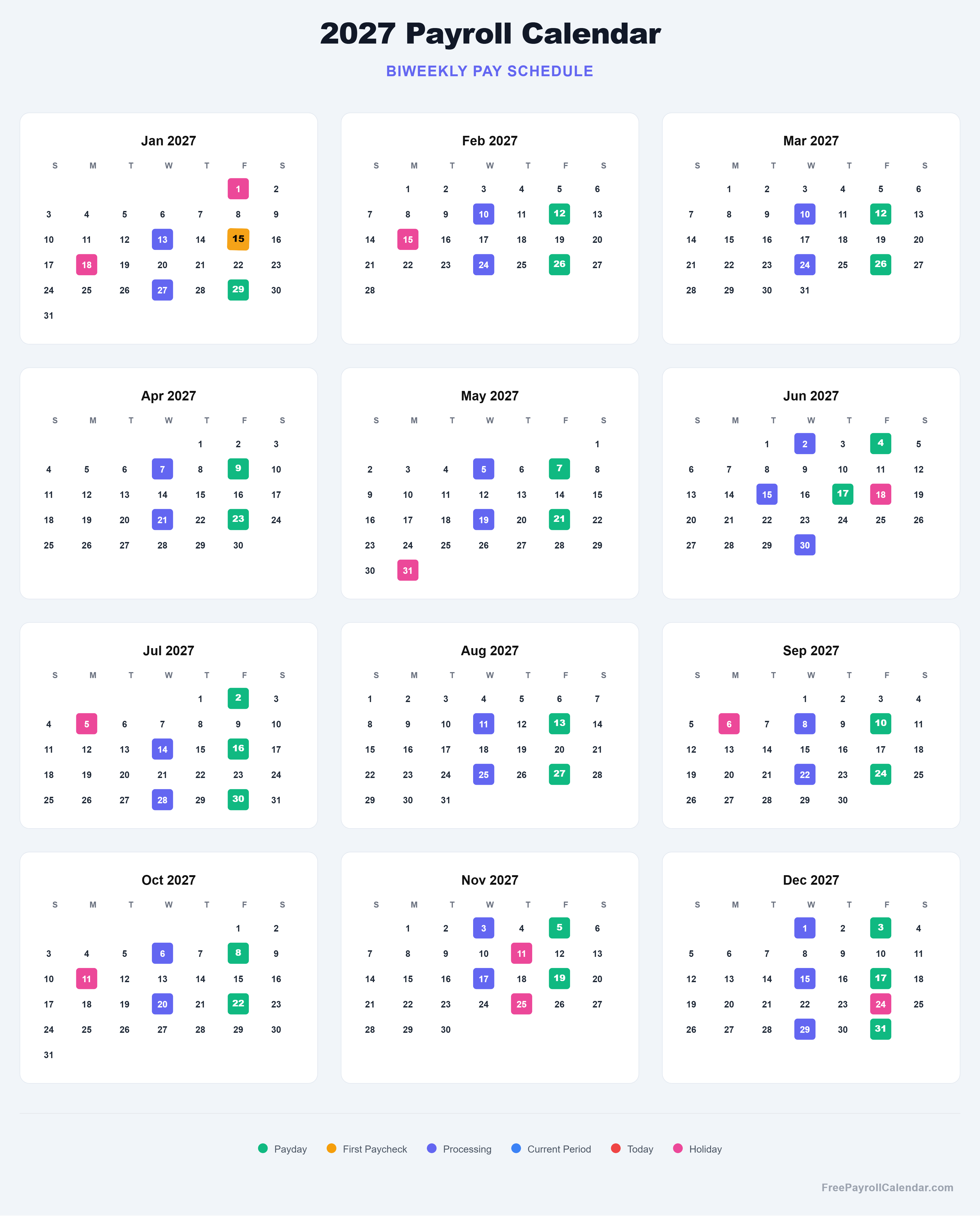
The two three-paycheck months of 2027
For most of the year, biweekly employees receive two paychecks a month, but the extra days that accumulate from 14-day pay cycles mean two months a year get a third payday instead. In 2027, those months are July and December. December's third paycheck lining up right before the new year is a genuinely useful coincidence for holiday spending - but it's worth resisting the urge to treat it as free money. If your household budget assumes "two paychecks per month," the third one is the easiest opportunity all year to build an emergency fund or knock out a lingering bill.
Is 2027 a 26 or 27 Pay Period Year?
Every few years, biweekly payroll administrators confront the "27 pay period anomaly"—a calendar phenomenon where 52 weeks (364 days) plus leap days create a 27th payday in a single calendar year. In 2027, there are exactly 26 pay periods.
Because 2027 is a standard 365-day non-leap year starting on a Friday, the biweekly calendar starts on Friday, January 15, 2027 and concludes on Friday, December 31, 2027. Employers do not need to adjust annual salary division calculations (dividing by 26 remains the standard divisor), and annual employee salary agreements will disburse as expected without pay-per-period reductions.
IRS W-2 Tax Implications for the December 31, 2027 Payday
The placement of Payday #26 on Friday, December 31, 2027 has major tax implications for both employees and corporate payroll accounting:
- Tax Year Allocation: IRS tax rules dictate that income is taxable in the calendar year it is received (constructive receipt). Because the final 2027 payday lands on December 31, all gross wages and withholdings from this paycheck will report on your 2027 Form W-2, even though the underlying work period extends into late December.
- Retirement Contribution Caps: If you are planning to max out your 401(k), 403(b), or HSA annual contribution limits in 2027, calculate your per-paycheck contribution percentage across all 26 paychecks. The December 31 payday is your last chance to reach annual IRS contribution ceilings.
- Flexible Spending Accounts (FSA): Ensure any healthcare FSA funds subject to the "use-it-or-lose-it" rule are spent before December 31, as claims must align with plan year guidelines.
Federal Bank Holiday Adjustments in 2027
When scheduled paydays or payroll processing windows land on Federal Reserve bank holidays, direct deposit processing dates must shift forward by one business day:
- New Year's Day (Friday, January 1, 2027): For companies with Friday paydays, payroll files must settle on Thursday, December 31, 2026.
- Christmas Day (Observed Friday, December 24, 2027): Because Christmas Day (December 25) falls on a Saturday, federal banks observe the holiday on Friday, December 24. Any payday scheduled for Friday, December 24 will settle on Thursday, December 23, 2027.
- Independence Day (Observed Monday, July 5, 2027): July 4 falls on a Sunday, so banks close on Monday, July 5. Early-week timesheet submission deadlines must move to Friday, July 2.
Managing Employer Cash Flow for July & December 2027
For business owners, CFOs, and HR directors, 3-paycheck months represent a 50% increase in monthly payroll expenditure compared to standard 2-paycheck months. In 2027, both July and December feature three payroll runs. Finance teams should reserve cash buffers in Q2 and Q4 to comfortably meet payroll obligations, employer 401(k) matching funds, and state/federal payroll tax deposits without liquidity friction.
Why biweekly payday always lands on the same weekday
Unlike semi-monthly pay, which locks to calendar dates and drifts across weekdays, biweekly pay locks to a specific weekday (Friday, in this schedule) and simply repeats every 14 days regardless of what date that lands on. This is the easiest way to tell the two schedules apart if you're not sure which one applies to you: check whether your payday is always the same day of the week (biweekly) or always the same date of the month (semi-monthly).
Planning around December's extra paycheck
Because December 2027 includes three biweekly paydays, and the final one falls right on December 31, employees have an unusually well-timed opportunity to close out the year with extra liquidity for holiday costs or January bills that often arrive right after the new year (insurance renewals, property tax, annual subscriptions). Employers should also note the extra payroll run when forecasting December cash flow: three payroll cycles in one month is a meaningfully different liability than the usual two.