2029 Biweekly Payroll Calendar: Complete Pay Period & Financial Planning Guide
In 2029, personnel compensated on a standard biweekly pay schedule will receive 26 paychecks across the 52-week calendar year. The 2029 disbursement calendar initiates with the first deposit clearing on Friday, January 12, 2029 (covering the earnings period from Sunday, December 24, 2028 through Saturday, January 6, 2029) and reaches its year-end completion on Friday, December 28, 2029. With 2029 functioning as a standard 365-day non-leap year following the 2028 leap cycle, compensation structures return to standard baseline metrics across both corporate accounting platforms and employee budgeting models.Examine the prior year's schedule on the 2028 biweekly payroll calendar, or look ahead to the next decade kickoff on the 2030 biweekly payroll calendar. Organizations managing twice-monthly disbursements should consult our 2029 semi-monthly payroll calendar.
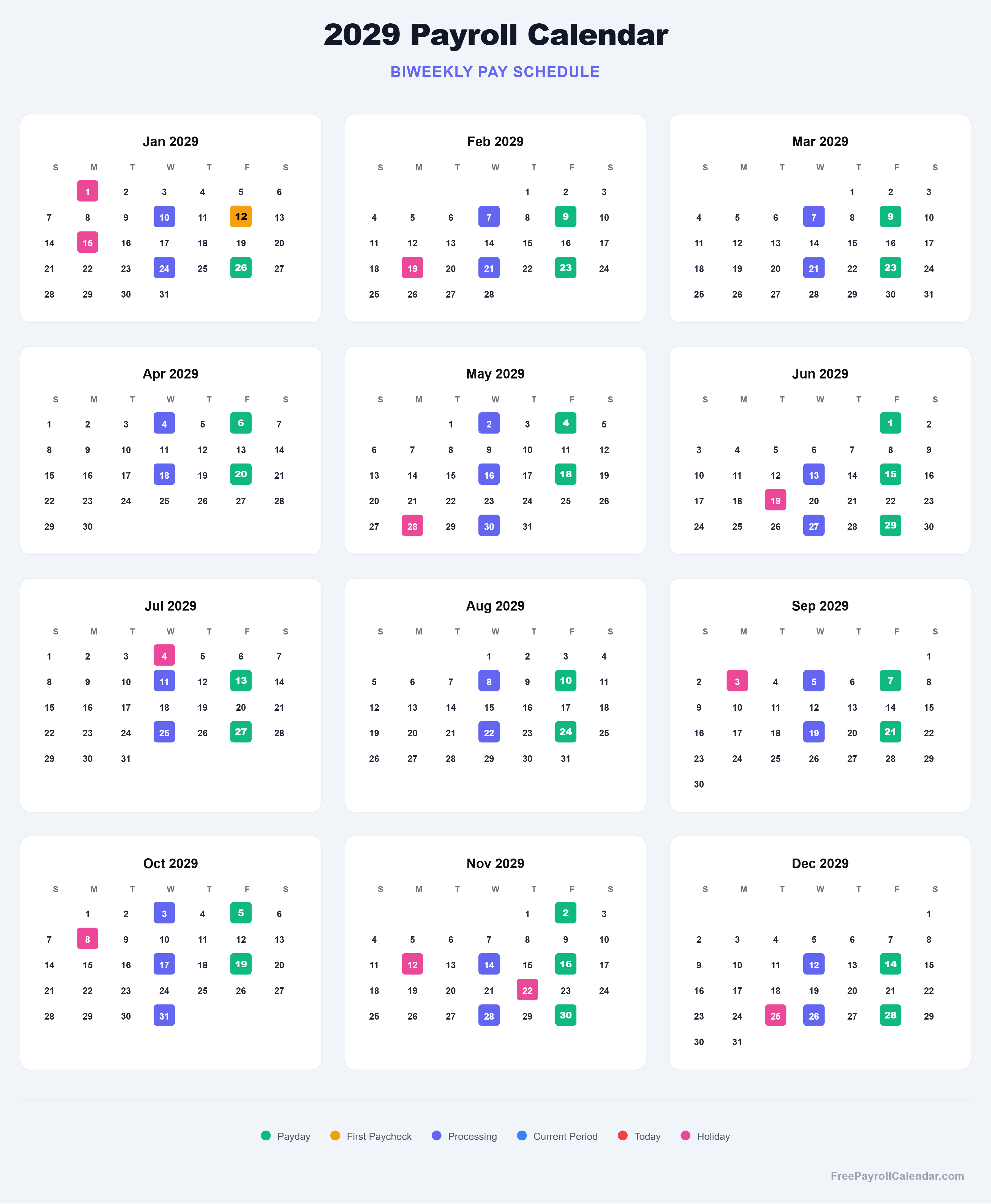
How Many Biweekly Pay Periods Are in 2029?
The 2029 biweekly schedule contains exactly 26 pay periods. Multiplying 26 two-week pay periods by 14 calendar days equals 364 days. Because a non-leap year comprises 365 days, a single leftover day rolls into the ongoing multi-year calendar accumulation. Because the first payday lands on January 12 rather than January 1 or 2, that surplus day does not cause a 27th pay period in 2029.
For enterprise human resource specialists and automated payroll software (such as ADP Workforce Now, Paychex Flex, Gusto, Workday, or Rippling), this means per-period gross wages for salaried workers divide cleanly by 26:
- An employee earning $52,000 annually receives exactly $2,000.00 gross per biweekly paycheck.
- An employee earning $78,000 annually receives exactly $3,000.00 gross per biweekly paycheck.
- An employee earning $104,000 annually receives exactly $4,000.00 gross per biweekly paycheck.
The Two Three-Paycheck Months of 2029: June and November
Because 26 pay periods cannot divide symmetrically into 12 calendar months, two months in 2029 will feature three paydays instead of the typical two. In 2029, the two three-paycheck months are June 2029 and November 2029:
- June 2029: Paychecks disburse on Friday, June 1, 2029, Friday, June 15, 2029, and Friday, June 29, 2029.
- November 2029: Paychecks disburse on Friday, November 2, 2029, Friday, November 16, 2029, and Friday, November 30, 2029.
The appearance of November as a three-paycheck month represents an extraordinary calendar alignment for employee personal finances. In most calendar years, the second three-paycheck month lands in late December or October. In 2029, landing on November 2, 16, and 30 places significant surplus liquidity directly into household accounts immediately before the peak holiday shopping season, Thanksgiving weekend, and annual winter travel.
Why November 2029 Deserves Dedicated Financial Planning
Unlike June's three-paycheck month, which arrives during early summer, November's third paycheck (clearing on Friday, November 30, 2029) hits right at the kickoff of holiday retail sales. Financial advisors emphasize that workers who prepare in advance can leverage this extra paycheck to eliminate holiday debt before it occurs:
- 100% Cash-Funded Holiday Season: Because routine living expenses (housing, car notes, utilities) are already covered by November's first two paychecks (Nov 2 and Nov 16), the November 30 paycheck can completely cash-fund December gifts, flights, and entertainment, preventing costly credit card balances.
- Year-End Tax-Advantaged Contributions: Depositing funds into health savings accounts (HSA) or individual retirement accounts (IRA) on November 30 gives investments an extra month of market exposure before annual December 31 contribution cutoffs.
- Heating & Property Tax Buffers: In many jurisdictions, semi-annual property tax installments or winter utility spikes fall in December or January. Ring-fencing November's bonus check provides an immediate shock absorber.
Employer Benefit Deduction Holidays in June and November 2029
For HR directors, controllers, and benefits specialists, three-paycheck months necessitate strict deduction scheduling. Employer-sponsored group health insurance, dental insurance, vision plans, and flexible spending accounts (FSA) are universally budgeted on a 24-deduction schedule (two deductions per month across twelve months).
During the third paycheck of June (June 29) and the third paycheck of November (November 30), payroll departments implement a benefit deduction holiday. On these two specific dates, voluntary health, dental, and vision insurance premiums are not deducted from gross pay. Statutory withholdings—including Federal Income Tax, FICA Social Security (6.2%), FICA Medicare (1.45%), and State/Local income taxes—continue to apply normally. Consequently, employees will notice a meaningful increase in net take-home pay on June 29 and November 30.
2029 Federal Reserve Banking Holidays & ACH Cutoff Deadlines
The National Automated Clearing House Association (NACHA) prohibits direct deposit funds settlements on Saturdays, Sundays, and official Federal Reserve bank holidays. To ensure employees receive their funds on scheduled Friday paydays, corporate payroll teams must submit NACHA payment files at least two business days prior to disbursement:
- New Year's Day (Monday, January 1, 2029): Banks are closed. While the first payday lands on Friday, January 12, timesheet collection for Pay Period #1 must accommodate the Monday holiday.
- Martin Luther King Jr. Day (Monday, January 15, 2029): Federal Reserve closed. ACH direct deposit files for the Friday, January 26 payday must be transmitted by Wednesday, January 24 at 5:00 PM EST.
- Presidents' Day (Monday, February 19, 2029): Closed nationwide. ACH transmissions for the Friday, February 23 payday must be finalized by Wednesday, February 21.
- Memorial Day (Monday, May 28, 2029): Federal banks close Monday. Because the first three-paycheck month begins on Friday, June 1, payroll managers must transmit ACH files by Wednesday, May 30 to ensure timely Friday morning clearing.
- Juneteenth National Independence Day (Tuesday, June 19, 2029): Banks close on Tuesday. Processing for the Friday, June 29 pay run must account for the mid-week banking pause.
- Independence Day (Wednesday, July 4, 2029): Mid-week closure. ACH files for the Friday, July 13 payday must be queued early.
- Labor Day (Monday, September 3, 2029): Closed. The Friday, September 7 payday requires file submission by Wednesday, September 5.
- Columbus Day / Indigenous Peoples' Day (Monday, October 8, 2029): Banks close. Processing for Friday, October 12 must be submitted by Wednesday, October 10.
- Veterans Day (Observed Monday, November 12, 2029): November 11 lands on Sunday, so banks observe the federal holiday on Monday, November 12. Payroll for the second November payday (Friday, November 16) must be processed with the Monday Federal Reserve closure in mind.
- Thanksgiving Day (Thursday, November 22, 2029): Banks closed nationwide. Because Thanksgiving falls immediately prior to an off-week for this cycle, submission schedules for the Friday, November 30 third paycheck should be pre-scheduled before the holiday weekend.
- Christmas Day (Tuesday, December 25, 2029): Banks close Tuesday. For the final annual payday on Friday, December 28, ACH files must be transmitted by Wednesday, December 26.
Why the 2029 Biweekly Payroll Closes on December 28
Under the biweekly 14-day cadence, Payday #26 falls on Friday, December 28, 2029. Under Treasury Regulation § 1.451-2 (constructive receipt rules), all income deposited on December 28, 2029 is legally earned and taxable in tax year 2029. All wages and withholdings will report completely on the employee's 2029 Form W-2. This provides a tidy administrative cutoff: no partial period carryover or payroll tax liability straddling into the 2030 tax filing year.
Biweekly vs. Semi-Monthly Payroll Comparison in 2029
Organizations weighing schedule structures in 2029 frequently compare biweekly to semi-monthly payroll:
- Disbursement Frequency: Biweekly pays 26 times per year on alternating Fridays. Semi-monthly pays exactly 24 times per year on static dates (typically the 15th and last day of each month).
- Paycheck Predictability: Biweekly pay is highly predictable for hourly workers tracking weekly schedules because paydays consistently land on Fridays. Semi-monthly paydays drift across different days of the week, shifting backward to Friday whenever the 15th or 30th falls on a weekend.
- Processing Costs: Semi-monthly involves two fewer payroll runs per year (24 vs. 26), which can slightly reduce per-payroll software processing charges for small businesses. However, biweekly remains significantly more popular with frontline staff due to the regular 14-day cash flow cycle.
Formulas for 2029 Biweekly Wage Calculations
To compute period gross compensation on a 2029 biweekly calendar:
- Salaried Workers:
Biweekly Gross = Annual Base Salary ÷ 26. - Hourly Workers:
Biweekly Gross = (Hourly Rate × Regular Hours up to 80) + (1.5 × Hourly Rate × Overtime Hours).
Utilize our interactive time card calculator to aggregate daily shift hours, or calculate exact statutory tax withholdings with our paycheck calculator. If you need to translate wages between annual, monthly, and hourly rates, use our salary converter.
Multi-Frequency Planning Across 2029 Payroll Calendars
Access our complete suite of 2029 payroll scheduling resources:
- 2029 Weekly Payroll Calendar — 52 weekly pay dates and hourly shift models.
- 2029 Semi-Monthly Payroll Calendar — 24 fixed-date pay periods on the 15th and end of month.
- 2029 Monthly Payroll Calendar — 12 monthly pay dates for executives and retirees.
- 50-State Pay Frequency Laws — Legal mandates governing wage payments across all US jurisdictions.
- Business Days Calculator — Accurately count banking business days and settlement timeframes.
- PTO Accrual Calculator — Plan paid time off balances across every 2029 pay period.