2029 Semi-Monthly Payroll Calendar: Complete 24-Period Pay Schedule & Compliance Guide
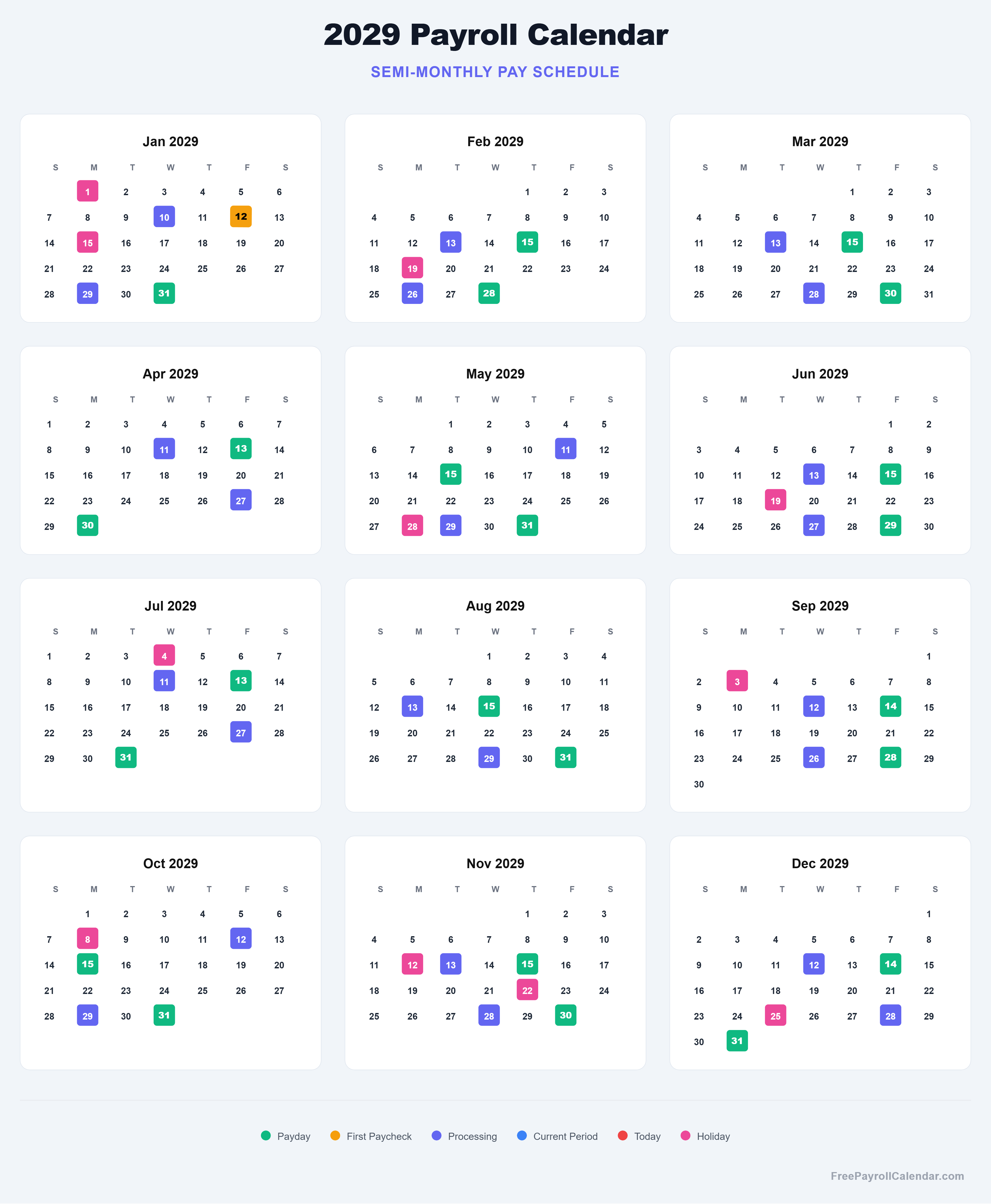
In 2029, employers managing exempt salaried personnel and corporate teams on a semi-monthly schedule will disburse exactly 24 paychecks across the year. The annual payroll cycle commences with the first disbursement on Friday, January 12, 2029 (advancing from Monday, January 15 due to the Martin Luther King Jr. Day federal banking holiday) and concludes with the 24th disbursement on Monday, December 31, 2029.Compare operational dates with the 2029 biweekly payroll calendar (which features three-paycheck months in June and November) or the shift-focused 2029 weekly payroll calendar. You can also review historical data on the 2028 semi-monthly payroll calendar or plan forward using the 2030 semi-monthly payroll calendar.
Why the First Payday of 2029 Shifts to Friday, January 12
The most noteworthy payroll scheduling nuance in 2029 occurs immediately at the start of the year. January 15, 2029 falls on a Monday—a standard business day. However, because it is Martin Luther King Jr. Day, an official Federal Reserve banking holiday, commercial banking wire services and the Automated Clearing House (ACH) network are fully closed nationwide.
Under standard corporate payroll governance and state prompt-payment statutes, an employer cannot push a holiday payday later to Tuesday, as this would violate contractual pay agreements and prompt payment statutes (such as California Labor Code § 204). Instead, the direct deposit advances to the preceding business day: Friday, January 12, 2029. Payroll administrators must transmit ACH direct deposit files no later than Wednesday, January 10 to ensure guaranteed employee settlement on Friday morning.
Weekend Rollback Rules & Banking Holidays in 2029
National Automated Clearing House Association (NACHA) banking regulations require direct deposits to settle on open commercial banking days. When the 15th or final calendar day falls on a weekend, funds advance to the closest preceding business day (usually Friday):
- March Month-End: March 31, 2029 is a Saturday. Payday advances to Friday, March 30, 2029.
- April Mid-Month: April 15, 2029 is a Sunday. Payday advances to Friday, April 13, 2029.
- June Month-End: June 30, 2029 is a Saturday. Payday advances to Friday, June 29, 2029.
- July Mid-Month: July 15, 2029 is a Sunday. Payday advances to Friday, July 13, 2029.
- September Mid-Month: September 15, 2029 is a Saturday. Payday advances to Friday, September 14, 2029.
- September Month-End: September 30, 2029 is a Sunday. Payday advances to Friday, September 28, 2029.
- December Mid-Month: December 15, 2029 is a Saturday. Payday advances to Friday, December 14, 2029.
- December Month-End: December 31, 2029 is a Monday. Payday settles on Monday, December 31, 2029.
Semi-Monthly vs. Biweekly Payroll: Operational Comparison
Review the fundamental differences between semi-monthly and biweekly payroll architectures for 2029:
| Dimension | Semi-Monthly Payroll (24 Checks) | Biweekly Payroll (26 Checks) |
|---|---|---|
| Disbursements / Year | Exactly 24 paychecks every year | 26 paychecks (27 every 11 years) |
| Schedule Anchor | Fixed dates (15th & month-end) | Every 14 days (typically Friday) |
| $90,000 Gross Pay / Check | $3,750.00 gross per paycheck | $3,461.54 gross per paycheck |
| Three-Paycheck Months | None — always 2 paychecks each month | 2 months per year (June & Nov in 2029) |
| Benefits Administration | Deducted evenly across all 24 periods | Requires 2 "benefit deduction holidays" |
| FLSA Hourly Overtime | Complex: split workweeks require reconciliation | Simple: aligned to two 7-day workweeks |
Overtime Calculation Complexities Under the FLSA: Split Workweeks
Managing non-exempt hourly employees on a semi-monthly payroll cadence requires understanding the overtime mandates of the Fair Labor Standards Act (FLSA) (29 U.S.C. § 207):
- Non-Averaging Principle: Employers cannot calculate overtime on a semi-monthly basis, nor can they average hours across a 15-day or 16-day pay period. Overtime must strictly be determined based on an established, recurring workweek consisting of 7 consecutive 24-hour periods (168 consecutive hours).
- Split Workweek Cutoffs: When a semi-monthly pay period terminates on the 15th or month-end, the cutoff date will frequently fall mid-week (such as on Tuesday or Wednesday). The 7-day workweek is split across two distinct pay periods.
- Pay Timing Rules (29 C.F.R. § 778.106): If overtime cannot be determined until the full 7-day workweek concludes, the employer must disburse straight-time earnings on the current paycheck for the hours worked through the cutoff date. The overtime premium due for the workweek must then be paid on the following paycheck once the full workweek has closed.
Model complex overtime scenarios and split-shift rates using our overtime calculator and time card calculator.
State Pay Frequency Laws & Statutory Compliance
Semi-monthly payroll complies with statutory frequency mandates in almost every U.S. state, but employers must adhere to specific prompt-payment deadlines:
- California Labor Code § 204: Requires all wages to be paid at least twice per month on established paydays. Earnings between the 1st and 15th must be paid between the 16th and 26th of the current month; earnings between the 16th and month-end must be paid between the 1st and 10th of the following month.
- New York Labor Law § 191: Prohibits semi-monthly pay for manual labor personnel (who must receive weekly paychecks within 7 calendar days). Semi-monthly pay is legally permitted for executive, professional, and clerical roles.
- Texas Payday Law: Mandates semi-monthly pay at minimum for non-exempt hourly employees, while exempt salaried staff may be paid on a monthly frequency.
Consult our full State Pay Frequency Laws reference guide for statutory rules across all 50 states.
2029 Federal Reserve Banking Holidays & ACH Cutoff Deadlines
Under NACHA direct deposit guidelines, direct deposits cannot settle on weekends or Federal Reserve banking holidays. Employers must observe the following 2029 banking closures:
- New Year's Day (Monday, January 1, 2029): Federal Reserve closed. Transmissions for the January 12 payday are unaffected.
- Martin Luther King Jr. Day (Monday, January 15, 2029): Banks closed. Scheduled mid-month payday advances to Friday, January 12.
- Washington's Birthday / Presidents' Day (Monday, February 19, 2029): Banks closed. Direct deposit batches for the February 28 payday must be transmitted by Friday, February 23.
- Memorial Day (Monday, May 28, 2029): Banks closed. The May 31 month-end payday requires ACH origination no later than Thursday, May 24.
- Juneteenth National Independence Day (Tuesday, June 19, 2029): Federal Reserve closed. Mid-month June paydays settle normally.
- Independence Day (Wednesday, July 4, 2029): Banks closed. ACH submissions for the July 13 payday must account for the mid-week holiday.
- Labor Day (Monday, September 3, 2029): Banks closed. Direct deposits for the September 14 payday must be initiated by Thursday, September 9.
- Columbus Day / Indigenous Peoples' Day (Monday, October 8, 2029): Banks closed. Submit mid-October payroll batches by Tuesday, October 9.
- Veterans Day (Observed Monday, November 12, 2029): November 11 is Sunday; Federal Reserve observes on Monday, November 12. Mid-November payday on November 15 requires ACH submission by Tuesday, November 13.
- Thanksgiving Day (Thursday, November 22, 2029): Closed nationwide. ACH files for the November 30 payday must be submitted before Thanksgiving Wednesday.
- Christmas Day (Tuesday, December 25, 2029): Federal Reserve banks closed. The final annual payday on Monday, December 31 requires ACH origination no later than Thursday, December 27.
IRS Constructive Receipt & 2029 Year-End W-2 Reconciliation
Under IRS Treasury Regulation § 1.451-2, wages are taxable in the calendar year during which they are constructively received by the worker. Because December 31, 2029 is a Monday, the 24th and final semi-monthly payday of 2029 settles cleanly on Monday, December 31, 2029.
Because funds are deposited into employee accounts on December 31, 2029, 100% of these wages, federal income tax withholdings, Social Security taxes (up to the 2029 statutory wage cap), and Medicare taxes report on the 2029 Form W-2.
For employers that disburse wages with a payroll lag (e.g., paying December 16–31 earnings on Wednesday, January 2, 2030), those wages are constructively received in 2030 and must report on the 2030 Form W-2.
Formulas for Calculating 2029 Semi-Monthly Gross Pay
Standard arithmetic formulas for computing semi-monthly gross compensation:
- Salaried Exempt Employees:
Gross Pay Per Check = Annual Contract Salary ÷ 24.- An annual salary of $72,000 yields $3,000.00 gross per paycheck ($6,000.00 monthly).
- An annual salary of $96,000 yields $4,000.00 gross per paycheck ($8,000.00 monthly).
- An annual salary of $120,000 yields $5,000.00 gross per paycheck ($10,000.00 monthly).
- Hourly Non-Exempt Employees:
Gross Pay = (Total Regular Hours in Period × Rate) + (All Overtime Hours in Included Workweeks × 1.5 × Rate). - Hourly Conversion: To convert an annual salary to an equivalent hourly wage on a 2,080-hour baseline:
Hourly Equivalent = Annual Salary ÷ 2,080.
Use our paycheck calculator, salary calculator, and business days calculator to model take-home pay, tax withholdings, and ACH turnaround times.
Related 2029 Payroll Calendars and Compliance Tools
Access our complete suite of 2029 payroll schedule templates and payroll calculation engines:
- 2029 Biweekly Payroll Calendar — 26-paycheck schedule with 3-paycheck month breakdowns.
- 2029 Weekly Payroll Calendar — 52 weekly pay dates with shift scheduling support.
- 2029 Monthly Payroll Calendar — 12 executive and board compensation disbursement dates.
- 2030 Semi-Monthly Payroll Calendar — Forward planning guide for the 2030 semi-monthly calendar.
- State Pay Frequency Laws — Statutory compliance regulations across all 50 states.
- ACH Settlement Calculator — Determine exact bank deposit settlement dates.
- Time Card Calculator — Total weekly shifts and compute gross wages.