2028 Semi-Monthly Payroll Calendar: Complete 24-Period Schedule & Leap Year Guide
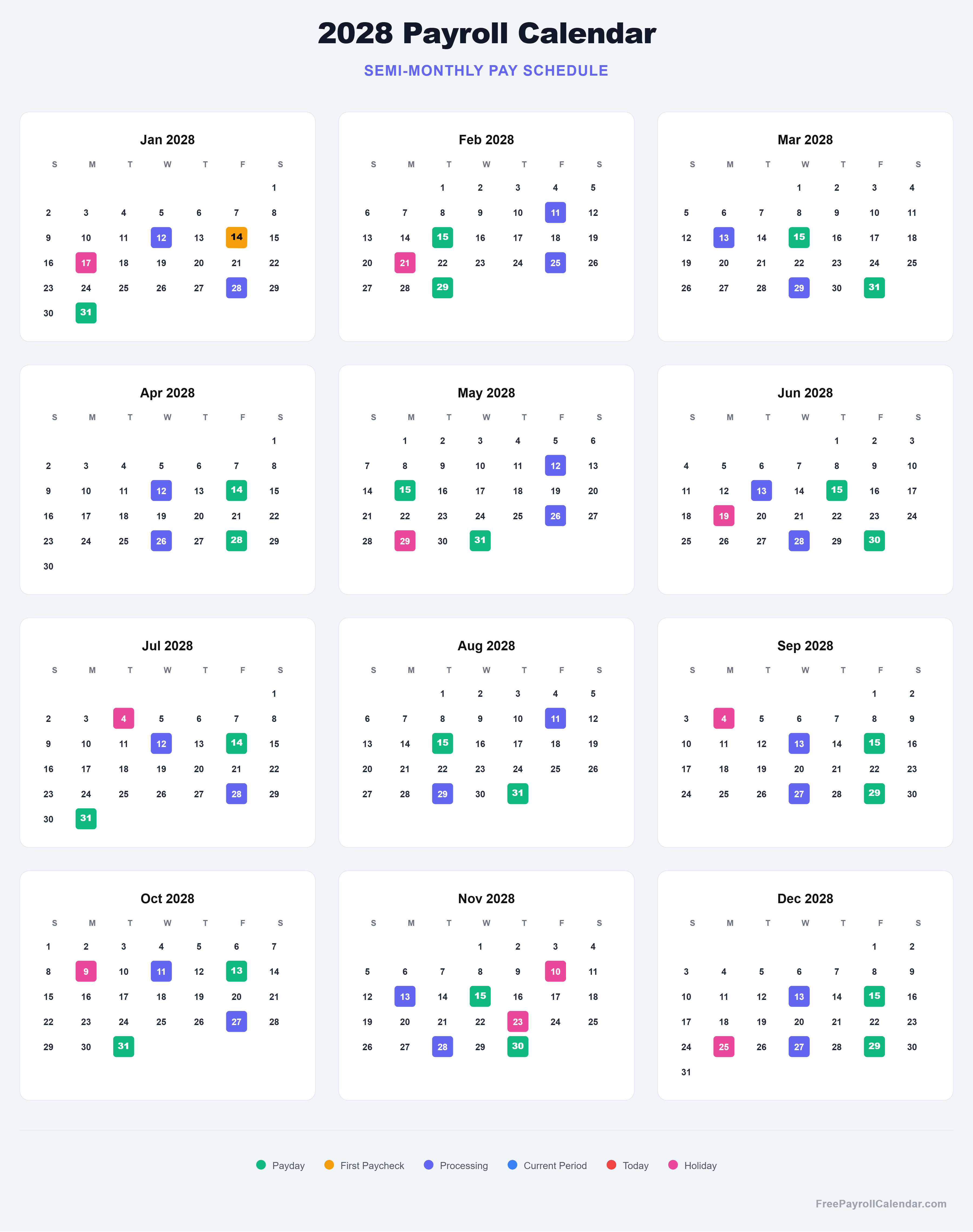
In 2028, organizations operating on a semi-monthly payroll cadence will execute exactly 24 pay periods across the calendar year. The pay cycle initiates with the first disbursement on Friday, January 14, 2028 (advancing from Saturday, January 15) and concludes with the 24th disbursement on Friday, December 29, 2028 (advancing from Sunday, December 31). Because 2028 is a leap year containing 366 days, finance directors, HR managers, and corporate payroll administrators must navigate specific operational factors—most notably how the leap day on Tuesday, February 29 impacts hourly wage tracking, timesheet cutoffs, and banking settlement schedules.Compare dates with the 2028 biweekly payroll calendar (featuring leap year pay period mechanics) or the shift-focused 2028 weekly payroll calendar. You can also review historical data on the 2027 semi-monthly payroll calendar or plan ahead using the 2029 semi-monthly payroll calendar.
The 2028 Leap Year: Mechanics of February 29 on Semi-Monthly Payroll
The defining characteristic of 2028 is the presence of Tuesday, February 29, 2028. For payroll departments, the impact of this additional calendar day depends on whether workers are exempt salaried professionals or non-exempt hourly employees:
- Salaried Exempt Employees: Annual employment contracts guarantee a specified annual salary for the entire calendar year. Because semi-monthly payroll divides annual base pay across 24 equal disbursements, gross compensation per paycheck remains strictly
Annual Contract Salary ÷ 24. The second pay period in February (February 16 through February 29) spans 14 calendar days instead of the usual 13 days in non-leap years. However, salaried employees do not receive additional compensation, nor is their pay reduced in other months. - Hourly Non-Exempt Employees: Under the Fair Labor Standards Act (FLSA), hourly workers must be paid for every hour actually worked. Because February 29, 2028 is a Tuesday, full-time non-exempt employees working Monday-through-Friday schedules will physically work one additional business day (8 hours) during the second February pay period. Employers must ensure hourly payroll budgets reflect 261 or 262 working days in 2028 (2,088 to 2,096 annual hours) rather than the standard 2,080 hours.
- Timecard System Audits: Enterprise HR and time-tracking systems (such as Kronos, ADP eTime, Gusto, and Workday) must be verified prior to February 2028 to confirm that timecards acknowledge February 29 as an active date rather than throwing syntax errors or advancing timestamps straight to March 1.
Weekend Rollback Rules & Banking Holidays in 2028
National Automated Clearing House Association (NACHA) banking operating rules require direct deposits to settle on open commercial banking days. Under standard payroll policies and state wage payment statutes, when the 15th or final calendar day falls on a weekend, funds advance to the closest preceding business day (usually Friday):
- January Mid-Month: January 15, 2028 is a Saturday. Payday advances to Friday, January 14, 2028.
- April Mid-Month: April 15, 2028 is a Saturday. Payday advances to Friday, April 14, 2028.
- April Month-End: April 30, 2028 is a Sunday. Payday advances to Friday, April 28, 2028.
- July Mid-Month: July 15, 2028 is a Saturday. Payday advances to Friday, July 14, 2028.
- September Month-End: September 30, 2028 is a Saturday. Payday advances to Friday, September 29, 2028.
- December Month-End: December 31, 2028 is a Sunday. The 24th and final payday of 2028 advances to Friday, December 29, 2028.
Because payday moves earlier, payroll managers must submit ACH origination batches by Wednesday afternoon to ensure guaranteed Friday settlement.
Semi-Monthly vs. Biweekly Payroll: Operational Comparison
Review the differences between semi-monthly and biweekly payroll architectures for 2028:
| Dimension | Semi-Monthly Payroll (24 Checks) | Biweekly Payroll (26 Checks) |
|---|---|---|
| Disbursements / Year | Exactly 24 paychecks every year | 26 paychecks (27 every 11 years) |
| Schedule Anchor | Fixed dates (15th & month-end) | Every 14 days (typically Friday) |
| $96,000 Gross Pay / Check | $4,000.00 gross per paycheck | $3,692.31 gross per paycheck |
| Three-Paycheck Months | None — always 2 paychecks each month | 2 months per year (June & Dec in 2028) |
| Benefits Administration | Deducted evenly across all 24 periods | Requires 2 "benefit deduction holidays" |
| FLSA Hourly Overtime | Complex: split workweeks require reconciliation | Simple: aligned to two 7-day workweeks |
Overtime Calculation Complexities Under the FLSA: Split Workweeks
Managing non-exempt hourly staff on a semi-monthly schedule requires strict adherence to federal Department of Labor regulations under the Fair Labor Standards Act (FLSA) (29 U.S.C. § 207):
- Non-Averaging Principle: Employers cannot calculate overtime on a semi-monthly basis, nor can they average hours across a 15-day or 16-day pay period. Overtime must strictly be determined based on an established, recurring workweek consisting of 7 consecutive 24-hour periods (168 consecutive hours).
- Split Workweek Cutoffs: When a semi-monthly pay period terminates on the 15th or month-end, the cutoff date will frequently fall mid-week (such as on Tuesday or Wednesday). The 7-day workweek is split across two distinct pay periods.
- Pay Timing Rules (29 C.F.R. § 778.106): If overtime cannot be determined until the full 7-day workweek concludes, the employer must disburse straight-time earnings on the current paycheck for the hours worked through the cutoff date. The overtime premium due for the workweek must then be paid on the following paycheck once the full workweek has closed.
Model complex overtime scenarios and split-shift rates using our overtime calculator and time card calculator.
State Pay Frequency Laws & Statutory Compliance
Semi-monthly payroll complies with statutory frequency mandates in almost every U.S. state, but employers must adhere to specific prompt-payment deadlines:
- California Labor Code § 204: Requires all wages to be paid at least twice per month on established paydays. Earnings between the 1st and 15th must be paid between the 16th and 26th of the current month; earnings between the 16th and month-end must be paid between the 1st and 10th of the following month.
- New York Labor Law § 191: Prohibits semi-monthly pay for manual labor personnel (who must receive weekly paychecks within 7 calendar days). Semi-monthly pay is legally permitted for executive, professional, and clerical roles.
- Texas Payday Law: Mandates semi-monthly pay at minimum for non-exempt hourly employees, while exempt salaried staff may be paid on a monthly frequency.
Consult our full State Pay Frequency Laws reference guide for statutory rules across all 50 states.
2028 Federal Reserve Banking Holidays & ACH Cutoff Deadlines
Under NACHA direct deposit guidelines, direct deposits cannot settle on weekends or Federal Reserve banking holidays. Employers must observe the following 2028 banking closures:
- New Year's Day (Monday, January 3, 2028 observed): January 1 falls on Saturday; banks observe on Monday, January 3. Transmissions for the January 14 payday proceed normally.
- Martin Luther King Jr. Day (Monday, January 17, 2028): Federal Reserve closed. Timesheets for mid-January periods must be approved early.
- Washington's Birthday / Presidents' Day (Monday, February 21, 2028): Banks closed. Direct deposit batches for the February 29 payday must be transmitted by Thursday, February 24.
- Memorial Day (Monday, May 29, 2028): Banks closed. The May 31 month-end payday requires ACH origination no later than Thursday, May 25.
- Juneteenth National Independence Day (Monday, June 19, 2028): Federal Reserve closed. Mid-month June paydays settle normally.
- Independence Day (Tuesday, July 4, 2028): Banks closed. ACH submissions for the July 14 payday must account for the early week holiday.
- Labor Day (Monday, September 4, 2028): Banks closed. Direct deposits for the September 15 payday must be initiated by Thursday, September 10.
- Columbus Day / Indigenous Peoples' Day (Monday, October 9, 2028): Banks closed. Submit mid-October payroll batches by Tuesday, October 10.
- Veterans Day (Observed Friday, November 10, 2028): November 11 is Saturday; Federal Reserve observes on Friday, November 10. The mid-November payday on November 15 settles normally the following week.
- Thanksgiving Day (Thursday, November 23, 2028): Closed nationwide. ACH files for the November 30 payday must be submitted before Thanksgiving Wednesday.
- Christmas Day (Monday, December 25, 2028): Federal Reserve banks closed. The final annual payday on Friday, December 29 requires ACH origination no later than Wednesday, December 27.
IRS Constructive Receipt & 2028 Year-End W-2 Reconciliation
Under IRS Treasury Regulation § 1.451-2, wages are taxable in the calendar year during which they are constructively received by the worker. Because December 31, 2028 is a Sunday, the 24th and final semi-monthly payday of 2028 advances to Friday, December 29, 2028.
Because funds are deposited into employee accounts on December 29, 2028, 100% of these wages, federal income tax withholdings, Social Security taxes (up to the 2028 statutory wage cap), and Medicare taxes report on the 2028 Form W-2.
For employers that disburse wages with a payroll lag (e.g., paying December 16–31 earnings on Tuesday, January 2, 2029), those wages are constructively received in 2029 and must report on the 2029 Form W-2.
Formulas for Calculating 2028 Semi-Monthly Gross Pay
Standard arithmetic formulas for computing semi-monthly gross compensation:
- Salaried Exempt Employees:
Gross Pay Per Check = Annual Contract Salary ÷ 24.- An annual salary of $72,000 yields $3,000.00 gross per paycheck ($6,000.00 monthly).
- An annual salary of $96,000 yields $4,000.00 gross per paycheck ($8,000.00 monthly).
- An annual salary of $120,000 yields $5,000.00 gross per paycheck ($10,000.00 monthly).
- Hourly Non-Exempt Employees:
Gross Pay = (Total Regular Hours in Period × Rate) + (All Overtime Hours in Included Workweeks × 1.5 × Rate). - Hourly Conversion: To convert an annual salary to an equivalent hourly wage on a 2,080-hour baseline:
Hourly Equivalent = Annual Salary ÷ 2,080.
Use our paycheck calculator, salary calculator, and business days calculator to model take-home pay, tax withholdings, and ACH turnaround times.
Related 2028 Payroll Calendars and Compliance Tools
Access our complete suite of 2028 payroll schedule templates and payroll calculation engines:
- 2028 Biweekly Payroll Calendar — 26-paycheck schedule with leap year guidance.
- 2028 Weekly Payroll Calendar — 52 weekly pay dates with shift scheduling support.
- 2028 Monthly Payroll Calendar — 12 executive and board compensation disbursement dates.
- 2029 Semi-Monthly Payroll Calendar — Forward planning guide for the 2029 semi-monthly calendar.
- State Pay Frequency Laws — Statutory compliance regulations across all 50 states.
- ACH Settlement Calculator — Determine exact bank deposit settlement dates.
- Time Card Calculator — Total weekly shifts and compute gross wages.