2025 Biweekly Payroll Calendar
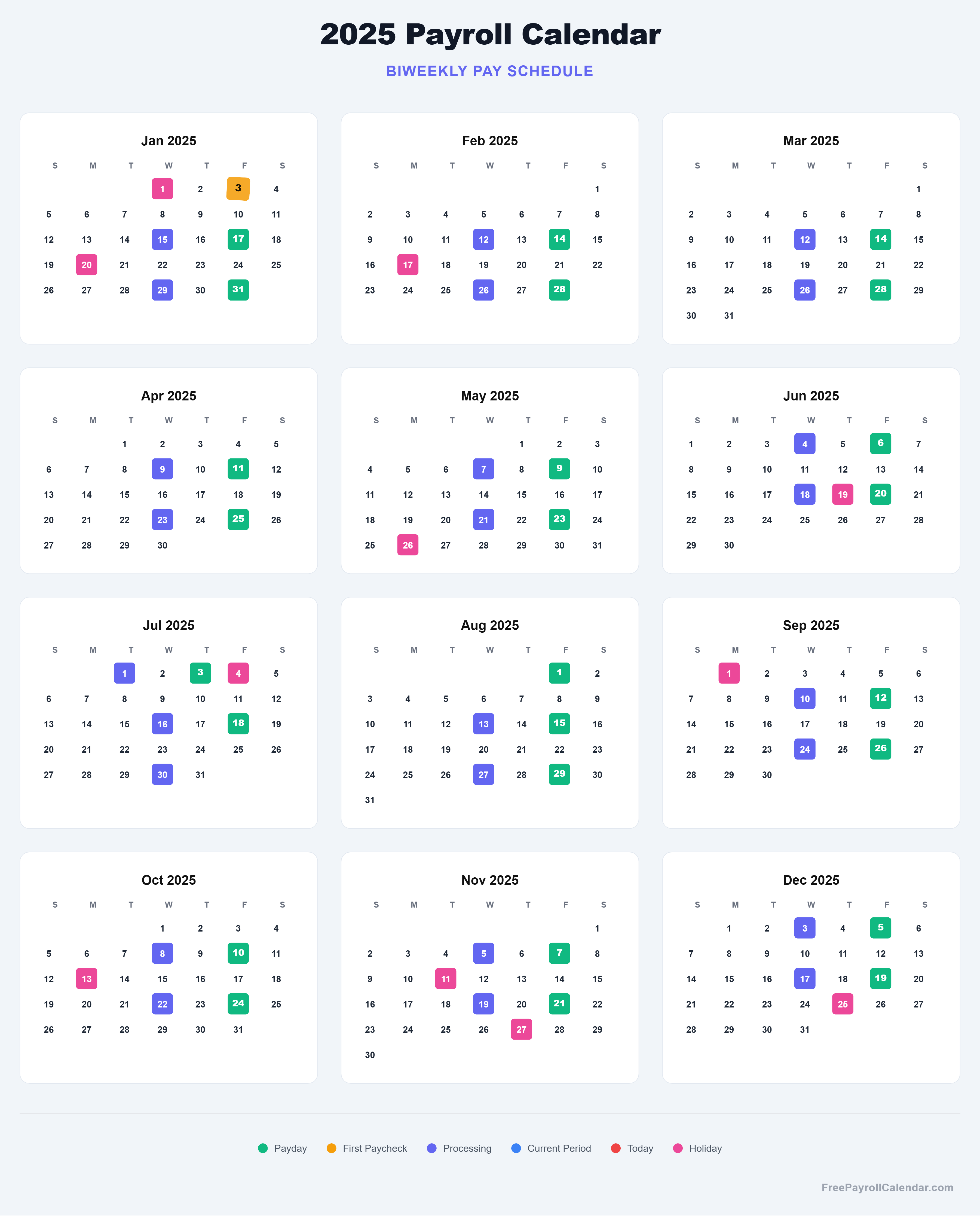
Biweekly pay is the most common pay cycle in the US private sector. Under the 2025 biweekly payroll calendar, employees receive exactly 26 paychecks over the course of the year. The first biweekly payday lands on Friday, January 3, 2025 (which covers hours worked from Dec 15, 2024 through Dec 28, 2024, depending on your company's payroll lag). The final payday of the year is scheduled for Friday, December 19, 2025.Planning ahead? Check out the biweekly pay schedule 2026. If your organization uses a twice-a-month cycle instead, explore the semi-monthly payroll calendar 2025.
How the 2025 Biweekly Cycle Operates
Operating on a biweekly schedule means processing payroll every two weeks, regardless of the calendar date. For employers, this system provides absolute consistency in processing timelines, typically requiring timesheet approvals on Monday or Tuesday prior to a Friday payday. For the 2025 fiscal year, maintaining this rhythm requires careful attention to specific dates, particularly those surrounding major federal holidays that disrupt banking operations. Since the Federal Reserve does not process ACH transfers on public holidays, companies must adjust their processing timelines to ensure direct deposits clear successfully on time.
The "Magic" Three Paycheck Months in 2025
A standard calendar year consists of 52 weeks and 1 day (or 2 days in a leap year). Because 52 weeks do not divide evenly into 12 calendar months, a biweekly cycle results in two "extra" pay periods every year. In 2025, employees paid on the standard Friday cycle will experience three-paycheck months in January and August.
From an employee perspective, these three-paycheck months are highly anticipated. If monthly living expenses (like rent, utilities, and groceries) are budgeted based on receiving two paychecks, that third paycheck acts as a cash flow surplus. Financial planners often recommend allocating this third check toward long-term savings, retirement contributions, or paying down high-interest debt, rather than treating it as disposable income. For employers, however, these months require heightened financial planning, as total cash outflow for payroll increases by 50% during January and August 2025. Benefit deductions may also need to be adjusted, as health insurance premiums are typically calculated over 24 pay periods rather than 26.
Navigating Federal Holiday Disruptions in 2025
One of the primary challenges of administering the 2025 biweekly payroll calendar is navigating bank holidays. If a payday falls on a Federal Reserve holiday, wages must typically be deposited on the preceding business day to comply with state labor laws and maintain employee trust.
In 2025, Independence Day falls on Friday, July 4th. For organizations utilizing a Friday payday, this means payroll must clear by Thursday, July 3rd. Consequently, HR teams will need to accelerate their timesheet collection, approval, and processing workflows by a full 24 hours earlier in the week. A similar acceleration is required around Thanksgiving (Thursday, November 27, 2025); while the standard Friday payday (Nov 28) is not a federal holiday, many banks operate on modified schedules or businesses observe a four-day weekend, necessitating early processing.
Administrative Best Practices for Employers
Running a smooth biweekly payroll in 2025 requires more than just following the dates. Employers should establish clear cutoff times for hourly workers to submit timesheets, usually Sunday evening at the end of the pay period. Managers must be trained to review and approve these hours by midday Monday. This leaves Tuesday for the payroll department to audit the data, calculate overtime in compliance with the Fair Labor Standards Act (FLSA), and submit the ACH file to the bank.
Additionally, businesses operating across multiple jurisdictions must monitor specific state pay frequency requirements. While biweekly is widely accepted, some states require manual laborers to be paid weekly. Ensuring that your workforce classification aligns with the 2025 biweekly calendar is essential for avoiding regulatory penalties.
Why Businesses Choose Biweekly Processing
When establishing a payroll infrastructure for 2025, many companies weigh the benefits of a two-week cycle against paying employees on specific calendar dates. Unlike cycles tied to the 1st and 15th, a biweekly system guarantees that processing always occurs on the exact same days of the week. This predictability makes it significantly easier to calculate overtime pay, as the standard 40-hour workweek aligns perfectly with the 14-day pay period boundary. For hourly workforces, the administrative burden of calculating split-week overtime across two different months is completely eliminated, reducing the likelihood of costly wage and hour compliance errors.
For employees, receiving compensation every 14 days provides a highly reliable cadence that aligns naturally with weekly expenses like groceries and gas, offering a distinct advantage in personal cash flow management compared to the longer gaps found in fixed-date pay structures.