2025 Monthly Payroll Calendar
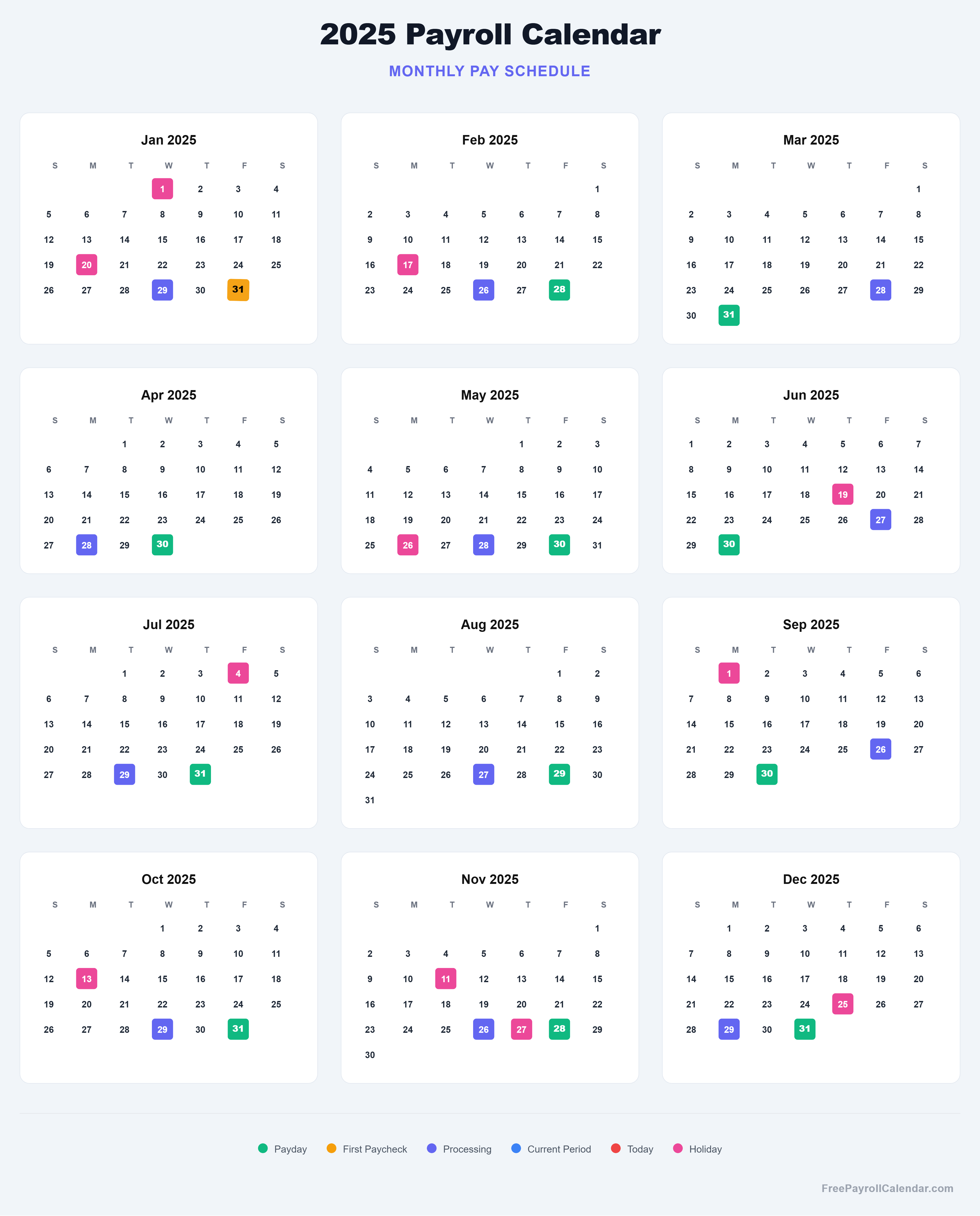
A monthly pay cycle is the most streamlined processing schedule available to employers, minimizing administrative overhead to just 12 events per year. Under the 2025 monthly payroll calendar, the first payday occurs on Friday, January 31, 2025, and the final paycheck of the year clears on Wednesday, December 31, 2025.Planning ahead? Check out the monthly pay schedule 2026. Looking for more frequent pay dates? Check out the semi-monthly pay schedule 2025.
The Mechanics of the 12-Paycheck Year
Running payroll just once a month drastically reduces the operational burden on HR and accounting teams. With only 12 ACH files to submit in 2025, businesses save significantly on per-transaction processing fees charged by payroll providers. Furthermore, the entire accounting cycle is perfectly aligned; wages earned in a given month are paid out and recorded in that exact same month, completely eliminating the need for wage accruals or complex ledger adjustments when closing the books.
Most organizations structure their monthly schedule to pay on the last day of the month. If the last day falls on a weekend or a federal holiday, standard practice dictates moving the payday forward to the preceding business day. In 2025, this adjustment is necessary in May (May 31 is a Saturday, moving pay to Friday, May 30) and August (August 31 is a Sunday, moving pay to Friday, August 29).
Budgeting Challenges for Employees
While highly advantageous for employers, a monthly schedule demands robust financial discipline from employees. Receiving a single lump-sum payment requires careful budgeting to ensure funds last a full 30 or 31 days. Workers must proactively manage their cash flow, timing their discretionary spending to avoid falling short before the next paycheck arrives. For this reason, companies that utilize this cycle often employ highly compensated, salaried professionals—such as executives, teachers, or specialized contractors—who possess the financial stability to comfortably bridge a four-week gap between payments.
Strict Compliance and State Restrictions
Before implementing a monthly cycle for the 2025 fiscal year, businesses must rigorously audit state labor laws. Because lengthy pay gaps can place financial strain on workers, many states explicitly prohibit monthly processing for the majority of the workforce. States like California, Massachusetts, and New York have stringent regulations requiring more frequent compensation for non-exempt and manual laborers.
Even in states where monthly processing is permitted, it is almost universally restricted to executive, administrative, or professional employees who meet specific exemption criteria under the Fair Labor Standards Act (FLSA). Paying hourly workers on this schedule is generally legally precarious and administratively difficult due to the complexities of tracking and paying overtime across such a lengthy period.
Handling 2025 Year-End Processing
The final month of the year is always the most critical for payroll administrators. In 2025, the final payday falls squarely on Wednesday, December 31st. Processing this payment correctly is paramount, as wages must be constructively received by the employee before midnight on December 31st to be recorded on their 2025 W-2 tax forms. Because the days leading up to this deadline are often disrupted by the Christmas holiday (Thursday, December 25) and subsequent long weekends, payroll departments must execute their final timesheet audits and ACH submissions well in advance to ensure funds settle into employee accounts before the new year begins.