2025 Semi-Monthly Payroll Calendar
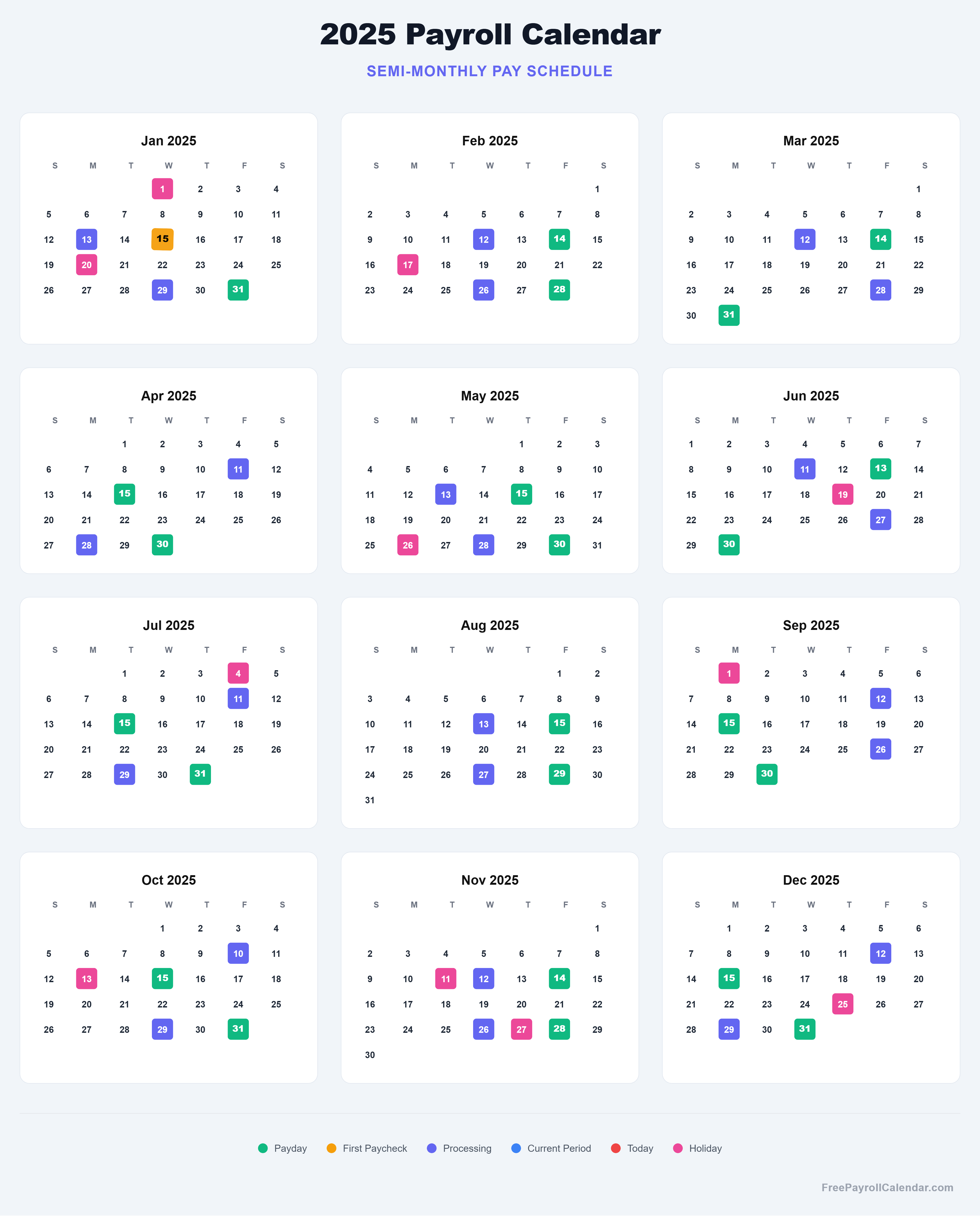
The semi-monthly pay cycle offers businesses highly predictable cash flow and simplified accounting. Under the 2025 semi-monthly payroll calendar, employees are paid exactly 24 times throughout the year. The most common structure dictates paydays on the 15th and the last day of the month. The first payday of 2025 falls on Wednesday, January 15, 2025, and the year concludes with a final paycheck on Wednesday, December 31, 2025.Planning ahead? Check out the semi-monthly pay schedule 2026. For the most common US pay cycle, see the biweekly pay schedule 2025.
Fixed Dates vs. Weekends in 2025
Unlike cycles that always land on a Friday, a semi-monthly schedule is tethered to specific calendar dates. This means paydays will naturally fall on weekends throughout the year. Standard payroll practice, mandated by many state labor laws, requires employers to pay workers on the preceding business day if a scheduled payday falls on a Saturday, Sunday, or bank holiday.
In the 2025 calendar year, this occurs several times. For instance, February 15th falls on a Saturday, meaning employees must be paid on Friday, February 14th. Similarly, March 15th and June 15th fall on weekends, requiring identical adjustments. Employers utilizing this structure must closely monitor these dates, as they shift the processing timeline forward and require earlier timesheet approvals.
Consistent Monthly Budgeting
Because there are exactly two paychecks issued every single month, the semi-monthly schedule eliminates the phenomenon of "three-paycheck months" seen in other cycles. For salaried employees, this provides an incredibly consistent and predictable cash flow. Every paycheck is exactly identical in gross amount, making it easier to align income with major fixed expenses like mortgages, rent, and auto loans, which are also billed on a monthly basis.
For the finance department, this structure is equally beneficial. Because 2025's payroll expenses are evenly distributed across all 12 months, creating financial forecasts, analyzing monthly profit and loss statements, and calculating benefit deductions becomes significantly more straightforward compared to fluctuating payroll cycles.
Handling Overtime for Hourly Workers
While excellent for salaried staff, administering a semi-monthly calendar in 2025 for hourly employees presents unique challenges. The Fair Labor Standards Act (FLSA) requires overtime to be calculated based on a fixed 168-hour (7-day) workweek. Because semi-monthly pay periods do not align cleanly with 7-day weeks—often splitting a week across two different pay periods—calculating overtime becomes a complex administrative hurdle. Payroll managers must track hours across the period boundary to ensure compliance. For this reason, many businesses reserve this schedule exclusively for their exempt, salaried workforce while keeping hourly workers on a different cycle.
Federal Holiday Intersections
When bank holidays align with the 15th or the last day of the month, employers must act proactively. In 2025, there are no major federal holidays that fall directly on the 15th or 31st of the month, offering a relatively smooth processing year compared to other cycles. However, holidays that fall immediately before processing deadlines—such as Thanksgiving on November 27th—can compress the window HR has to audit timesheets and submit ACH files. Preparing for these abbreviated workflows is essential for maintaining uninterrupted direct deposits.
Why Companies Choose Fixed-Date Processing
Choosing this structure for 2025 is often a strategic financial decision. It seamlessly integrates payroll expenses into standard monthly accounting periods, avoiding the need for complex month-end wage accruals. Benefit administration is also simplified, as health insurance and retirement contributions can be divided perfectly in half and deducted twice a month without needing adjustments for "extra" pay periods. When managing a primarily salaried workforce, this cycle offers the best balance of predictability for both the employee's wallet and the employer's ledger.