2030 Biweekly Payroll Calendar
Biweekly-paid employees will receive 26 paychecks in 2030, starting with Friday, January 4, 2030 (covering the pay period December 16–29, 2029) and closing out the year on Friday, December 20, 2030 (covering December 1–14, 2030).Need to reference last year? Review the biweekly payroll calendar 2029. If your organization uses a twice-a-month cycle instead, explore the semi-monthly payroll calendar 2030.
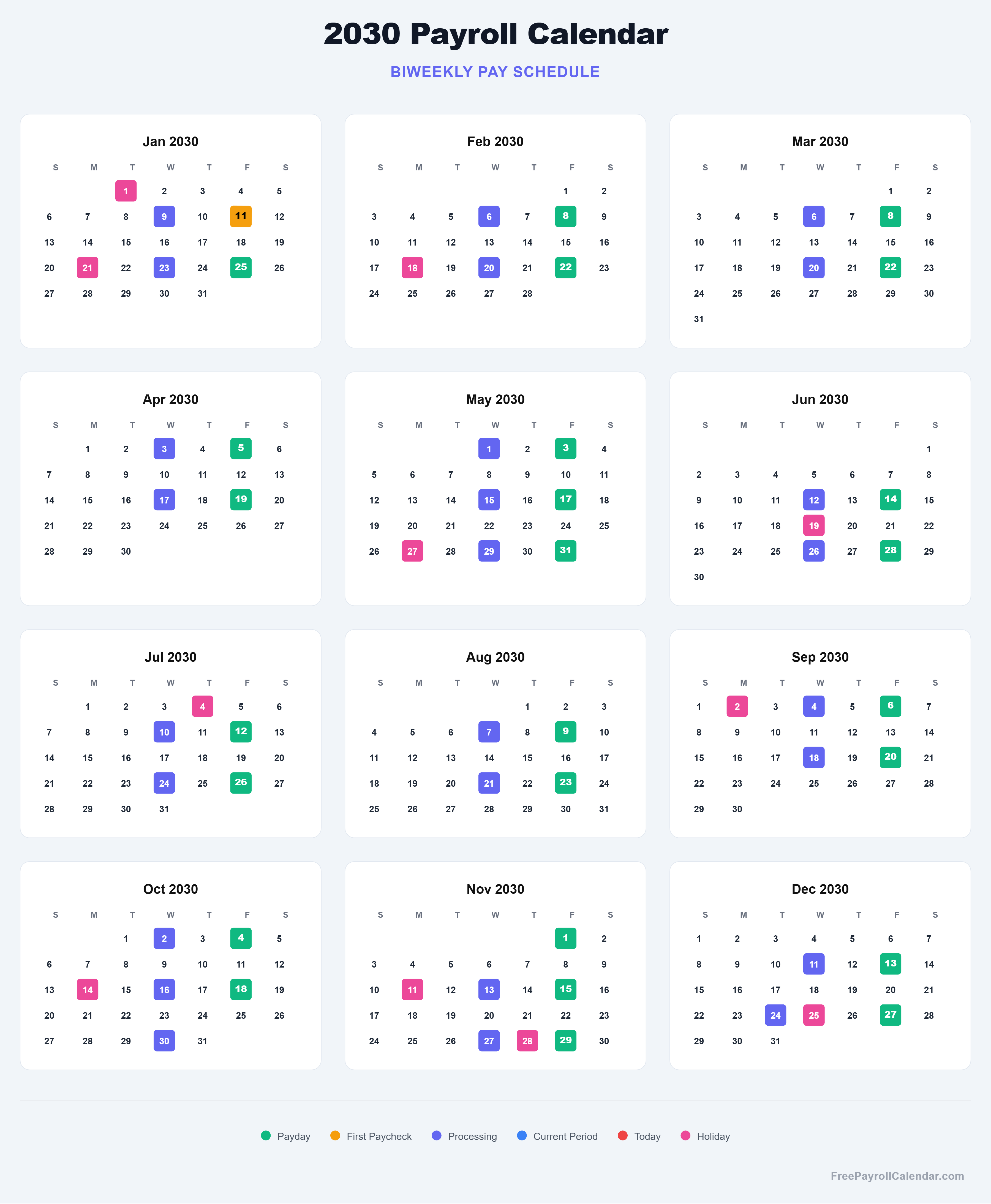
The two three-paycheck months in 2030
Most years produce two "bonus" months where a biweekly schedule lines up for three paydays instead of two, and 2030 is no exception. This year, the extra paychecks land in March and August:
- March 2030: Friday paydays on the 1st, 15th, and 29th
- August 2030: Friday paydays on the 2nd, 16th, and 30th
If your household budgets around two paychecks a month as the baseline, these are the two months to plan for something different - an extra loan payment, a head start on holiday savings, or simply a transfer straight into savings before it blends into everyday spending. Employers should flag the same two months for cash-flow planning, since each one requires funding an extra payroll run.
Why the year doesn't end on December 31
A biweekly cycle runs on 14-day blocks, and 26 of those blocks only add up to 364 days, which is one short of a full calendar year. That's why the final 2030 paycheck lands on December 20 rather than closer to New Year's Eve. The days between December 21 and December 31, 2030 simply roll into the pay period that funds the first paycheck of 2031. Nothing is missed; it's just where the math naturally lands, and the same drift happens every year regardless of your start date.
What makes 2030 a clean planning year: Unlike some years where a biweekly cycle bumps into a January holiday or a leap-year February, 2030 keeps things simple: no leap-year adjustment (2030 is not a leap year), and no federal holiday falls directly on a scheduled Friday payday. That makes it a reasonably easy year for HR teams to pre-load into payroll software or for employees to build a rough household budget around, without the extra layer of holiday-driven date shifts that complicate some other years.