Calendar dates are generated from the information you provide. Actual pay dates, payroll processing, direct deposits, bank holidays, and employer policies may vary. Please confirm official payroll schedules with your employer.
💰
Estimated paycheck amounts are for planning purposes only and may differ after taxes, deductions, retirement contributions, insurance, overtime, bonuses, or employer-specific payroll policies.
📅 Pre-Filled 2030 Weekly Table
Period #
Period Start
Period End
Pay Date
Status / Note
1
Dec 22, 2029
Dec 28, 2029
Friday, January 4, 2030
First paycheck of 2030
2
Dec 29, 2029
Jan 4, 2030
Friday, January 11, 2030
3
Jan 5, 2030
Jan 11, 2030
Friday, January 18, 2030
4
Jan 12, 2030
Jan 18, 2030
Friday, January 25, 2030
5
Jan 19, 2030
Jan 25, 2030
Friday, February 1, 2030
6
Jan 26, 2030
Feb 1, 2030
Friday, February 8, 2030
7
Feb 2, 2030
Feb 8, 2030
Friday, February 15, 2030
8
Feb 9, 2030
Feb 15, 2030
Friday, February 22, 2030
9
Feb 16, 2030
Feb 22, 2030
Friday, March 1, 2030
10
Feb 23, 2030
Mar 1, 2030
Friday, March 8, 2030
11
Mar 2, 2030
Mar 8, 2030
Friday, March 15, 2030
12
Mar 9, 2030
Mar 15, 2030
Friday, March 22, 2030
13
Mar 16, 2030
Mar 22, 2030
Friday, March 29, 2030
14
Mar 23, 2030
Mar 29, 2030
Friday, April 5, 2030
15
Mar 30, 2030
Apr 5, 2030
Friday, April 12, 2030
16
Apr 6, 2030
Apr 12, 2030
Friday, April 19, 2030
17
Apr 13, 2030
Apr 19, 2030
Friday, April 26, 2030
18
Apr 20, 2030
Apr 26, 2030
Friday, May 3, 2030
19
Apr 27, 2030
May 3, 2030
Friday, May 10, 2030
20
May 4, 2030
May 10, 2030
Friday, May 17, 2030
21
May 11, 2030
May 17, 2030
Friday, May 24, 2030
22
May 18, 2030
May 24, 2030
Friday, May 31, 2030
23
May 25, 2030
May 31, 2030
Friday, June 7, 2030
24
Jun 1, 2030
Jun 7, 2030
Friday, June 14, 2030
25
Jun 8, 2030
Jun 14, 2030
Friday, June 21, 2030
26
Jun 15, 2030
Jun 21, 2030
Friday, June 28, 2030
27
Jun 22, 2030
Jun 28, 2030
Friday, July 5, 2030
28
Jun 29, 2030
Jul 5, 2030
Friday, July 12, 2030
29
Jul 6, 2030
Jul 12, 2030
Friday, July 19, 2030
30
Jul 13, 2030
Jul 19, 2030
Friday, July 26, 2030
31
Jul 20, 2030
Jul 26, 2030
Friday, August 2, 2030
32
Jul 27, 2030
Aug 2, 2030
Friday, August 9, 2030
33
Aug 3, 2030
Aug 9, 2030
Friday, August 16, 2030
34
Aug 10, 2030
Aug 16, 2030
Friday, August 23, 2030
35
Aug 17, 2030
Aug 23, 2030
Friday, August 30, 2030
36
Aug 24, 2030
Aug 30, 2030
Friday, September 6, 2030
37
Aug 31, 2030
Sep 6, 2030
Friday, September 13, 2030
38
Sep 7, 2030
Sep 13, 2030
Friday, September 20, 2030
39
Sep 14, 2030
Sep 20, 2030
Friday, September 27, 2030
40
Sep 21, 2030
Sep 27, 2030
Friday, October 4, 2030
41
Sep 28, 2030
Oct 4, 2030
Friday, October 11, 2030
42
Oct 5, 2030
Oct 11, 2030
Friday, October 18, 2030
43
Oct 12, 2030
Oct 18, 2030
Friday, October 25, 2030
44
Oct 19, 2030
Oct 25, 2030
Friday, November 1, 2030
45
Oct 26, 2030
Nov 1, 2030
Friday, November 8, 2030
46
Nov 2, 2030
Nov 8, 2030
Friday, November 15, 2030
47
Nov 9, 2030
Nov 15, 2030
Friday, November 22, 2030
48
Nov 16, 2030
Nov 22, 2030
Friday, November 29, 2030
49
Nov 23, 2030
Nov 29, 2030
Friday, December 6, 2030
50
Nov 30, 2030
Dec 6, 2030
Friday, December 13, 2030
51
Dec 7, 2030
Dec 13, 2030
Friday, December 20, 2030
52
Dec 14, 2030
Dec 20, 2030
Friday, December 27, 2030
2030 Weekly Payroll Calendar
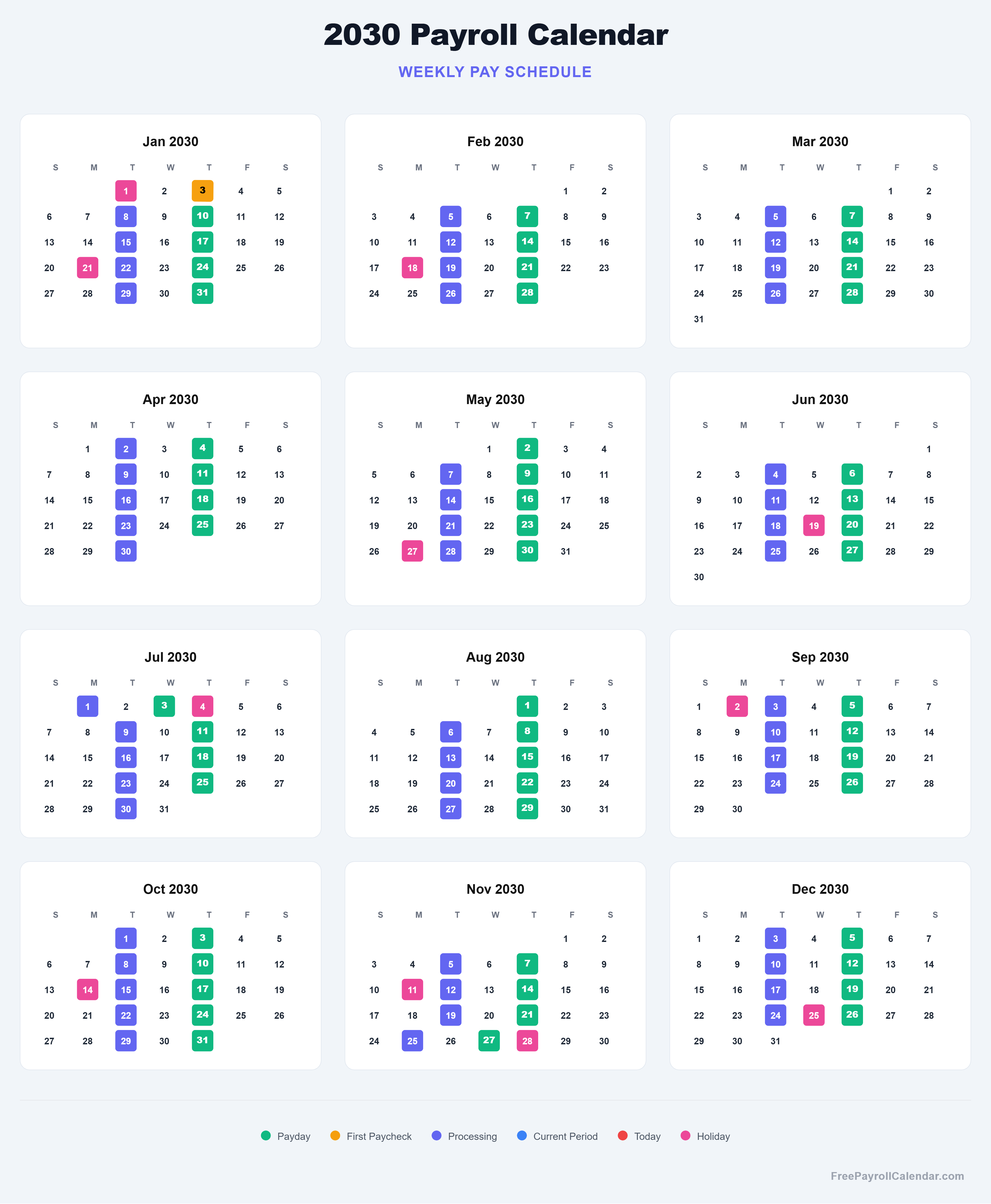
Weekly-paid employees will receive a standard 52 paychecks in 2030, starting with Friday, January 4, 2030 (covering December 22–28, 2029) and finishing the year on Friday, December 27, 2030.Need to reference last year? Review the weekly payroll calendar 2029. If your company pays less frequently, you can also view the biweekly payroll calendar 2030.
Click to view or download the full-size 2030 weekly payroll calendar chart.
Planning ahead for a standard payroll year
If you're setting up a payroll calendar years in advance, which is common for HR teams doing multi-year benefits and budget planning, 2030 is a useful anchor point precisely because it doesn't involve any of the complications seen in nearby years: no 53rd paycheck (like 2027), no leap-year timesheet considerations (like 2028), and no major fixed-date holiday collision shifting the first payday (like 2029's MLK Day situation). It's simply a clean 52-week cycle.
Why the last payday lands a few days before New Year's Eve
December 27, 2030 is the final Friday of the year, and December 31 that year falls on a Tuesday, four days later, which is simply outside the final 7-day pay period. This isn't an adjustment; it's just where the weekly cycle naturally lands. The pay period covering December 29–31 rolls into the first payday of 2031 instead.
What weekly-paid workers should still verify each year
Even in a straightforward year like 2030, it's worth confirming your specific employer's calendar against the general federal one - company-specific holiday observances (a floating holiday, an extra day off around Thanksgiving, a regional bank holiday) can shift an individual payday even when the broader federal calendar wouldn't require it.
Frequently Asked Questions - Weekly Payroll
When is the first weekly paycheck of 2030?
The first weekly paycheck of 2030 is paid on Friday, January 4, 2030, covering hours worked during the pay period of December 22 to December 28, 2029.
When is the last weekly paycheck of 2030?
The last weekly paycheck of 2030 lands on Friday, December 27, 2030.
Does 2030 have any leap-year or 53-paycheck complications?
No, 2030 is a standard non-leap year with a standard 52-paycheck cycle for standard Friday-based weekly pay schedules.
Why doesn't the last paycheck of 2030 fall closer to December 31?
Since weekly pay cycles are tied to a specific weekday (Friday, in this case) and December 31, 2030, falls on a Tuesday, the final paycheck of the year naturally clears on Friday, December 27, which is when the final full weekly pay period of the year concludes.
What happens to the days between December 27 and December 31, 2030?
The days between December 28 and December 31, 2030, are included in the pay period covered by the first weekly paycheck of 2031 rather than being counted in the 2030 payroll year.
Is it useful to plan a payroll calendar this far in advance?
Yes, it is highly beneficial, particularly for HR professionals and benefits teams who perform multi-year budget forecasting, labor contract planning, or early setup of recurring payroll software configurations.