2030 Monthly Payroll Calendar
Monthly-paid employees receive exactly 12 paychecks in 2030, one at or near the end of each month. The first payday of the year is Thursday, January 31, 2030, and the final payday lands on Tuesday, December 31, 2030, and both fall cleanly within their respective months, with no need to push into an adjacent year.Need to reference last year? Review the monthly payroll calendar 2029. Looking for more frequent pay dates? Check out the semi-monthly pay schedule 2030.
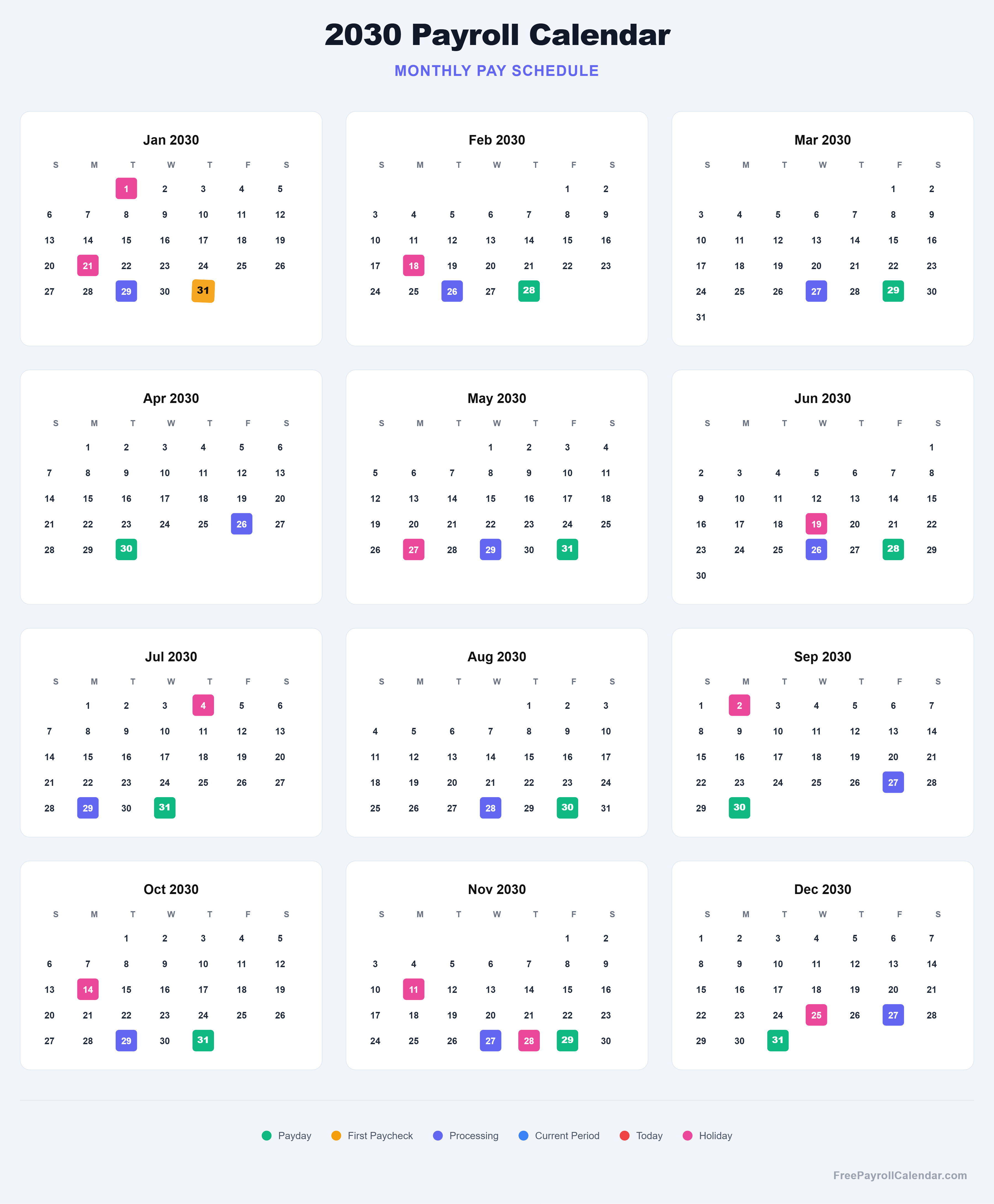
Every 2030 monthly payday, at a glance
| Month | Payday |
|---|---|
| January | Jan 31 (Thu) |
| February | Feb 28 (Thu) |
| March | Mar 29 (Fri, shifted from Sun Mar 31) |
| April | Apr 30 (Tue) |
| May | May 31 (Fri) |
| June | Jun 28 (Fri, shifted from Sun Jun 30) |
| July | Jul 31 (Wed) |
| August | Aug 30 (Fri, shifted from Sat Aug 31) |
| September | Sep 30 (Mon) |
| October | Oct 31 (Thu) |
| November | Nov 29 (Fri, shifted from Sat Nov 30) |
| December | Dec 31 (Tue) |
The four months that don't pay on the actual last day
March, June, August, and November 2030 all end on a weekend, so each of those paydays moves two or three days earlier to the closest preceding Friday. That's a third of the year where "payday" and "last day of the month" don't actually match, which is useful to know if you're scheduling rent or loan payments around your paycheck, since a Friday, August 30 deposit still has to stretch to cover expenses that don't land until the 31st or later.
Why 2030 is a relatively low-friction monthly year
There's no leap-year February to account for (2030 isn't a leap year, so February simply ends on the 28th), and no fixed federal holiday happens to fall on a month-end business day this year. The only complexity is the ordinary weekend drift affecting four months, which is about typical for any given calendar year and easy to plan around once you know which months to watch.
Monthly pay and the "one shot" budgeting problem
With only 12 deposits a year, a monthly schedule leaves the least room for error of any pay frequency: a single early-month expense has to be absorbed by that same paycheck, since the next one is a full 30 days away. Building a one-month cash buffer is the most common way monthly-paid employees smooth this out, so a delayed or smaller-than-expected paycheck doesn't cascade into missed bills later in the cycle. This is also why monthly pay is far more common among salaried roles with predictable expenses, such as executives, faculty, and government employees, than among hourly workers whose income can fluctuate week to week.