2026 Monthly Payroll Calendar

🚀 Configure Your Pay Schedule

When did you (or will you) start?
Days between pay period end and deposit
Shows estimated amount on each payday

📅 Pre-Filled 2026 Monthly Table

Period #Period StartPeriod EndPay DateStatus / Note
1Jan 1, 2026Jan 31, 2026Friday, January 30, 2026Weekend (Adjusted)
2Feb 1, 2026Feb 28, 2026Friday, February 27, 2026Weekend (Adjusted)
3Mar 1, 2026Mar 31, 2026Tuesday, March 31, 2026
4Apr 1, 2026Apr 30, 2026Thursday, April 30, 2026
5May 1, 2026May 31, 2026Friday, May 29, 2026Weekend (Adjusted)
6Jun 1, 2026Jun 30, 2026Tuesday, June 30, 2026
7Jul 1, 2026Jul 31, 2026Friday, July 31, 2026
8Aug 1, 2026Aug 31, 2026Monday, August 31, 2026
9Sep 1, 2026Sep 30, 2026Wednesday, September 30, 2026
10Oct 1, 2026Oct 31, 2026Friday, October 30, 2026Weekend (Adjusted)
11Nov 1, 2026Nov 30, 2026Wednesday, November 30, 2026
12Dec 1, 2026Dec 31, 2026Thursday, December 31, 2026

2026 Monthly Payroll Calendar

Monthly payroll is the simplest schedule to administer and the hardest to budget against as an employee - you get exactly 12 paychecks a year, and each one has to stretch across a full 30 days. In 2026, the first payday lands on Friday, January 30, 2026 (covering the full month of January), and the final payment of the year clears on Thursday, December 31, 2026.Need to reference last year? Review the monthly payroll calendar 2025. Planning ahead? Check out the monthly pay schedule 2027. Looking for more frequent pay dates? Check out the semi-monthly pay schedule 2026.
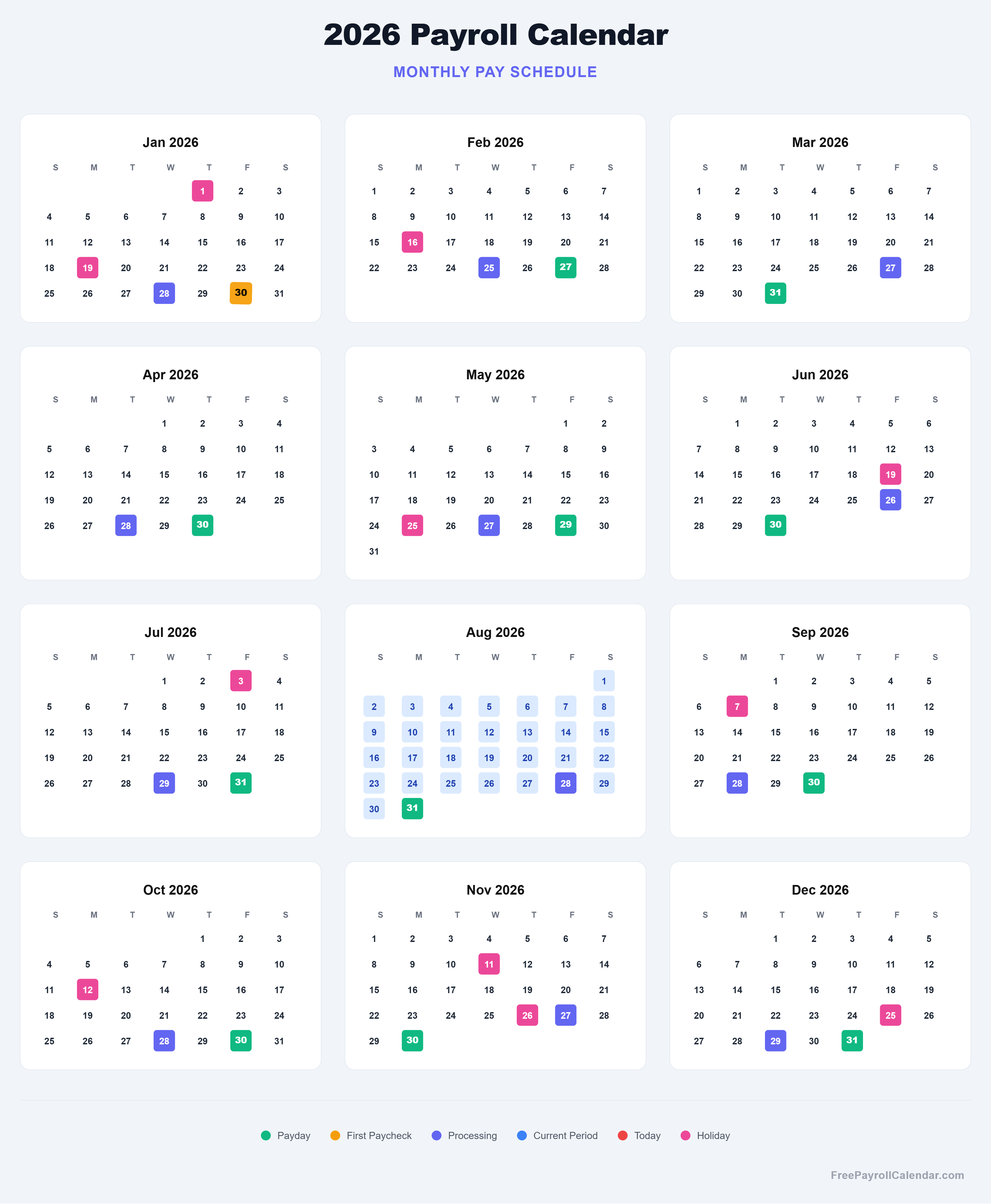
Visual layout of the 2026 monthly payroll calendar showing all months, payday dates, and processing periods.
Click to view or download the full-size 2026 monthly payroll calendar chart.

Why January's payday isn't the 31st: You might expect month-end pay to land on the 31st, but January 31, 2026 falls on a Saturday - banks don't process ACH transfers on weekends, so the deposit shifts to the preceding business day, Friday, January 30. This is the most common source of confusion for people new to monthly pay: the "last day of the month" and "payday" are only the same date when the last day happens to be a weekday.

Who actually gets paid monthly, and why

Monthly schedules are most common among salaried executives, university faculty, and government employees - roles where administrative simplicity matters more than employee cash-flow comfort. From the employer's side, processing payroll 12 times a year instead of 24 or 52 dramatically cuts down on bank fees, software processing costs, and HR hours spent per pay cycle. The tradeoff lands entirely on the employee: a single missed or delayed paycheck means waiting a full month for the next one, so monthly-paid workers typically need stronger personal budgeting discipline or a cash buffer.

Monthly vs. biweekly: the budgeting gap

The core difference isn't just paycheck frequency - it's cash-flow rhythm. Biweekly employees get a check every two weeks, meaning even a bad month is only ever two weeks from resolution. Monthly employees are managing a 30-day runway on a single deposit, which means one unexpected expense early in the month has to be absorbed by that same paycheck rather than smoothed out by another one arriving soon after.

Printable 2026 Payroll Calendar

Update your bank processing schedule to accommodate holiday bank closures in 2026. Submitting direct deposits early keeps payments on time. Save a copy of the 2026 monthly payroll calendar pdf or print this table for reference.

Frequently Asked Questions - Monthly Payroll

When is the first payday of 2026 for monthly pay?

Friday, January 30, 2026, because January 31 falls on a Saturday.

How many monthly paychecks are there in 2026?

Exactly 12 - one per calendar month, with no three-paycheck months like biweekly schedules experience.

Why does the December 2026 paycheck land on December 31 and not January 2027?

Because December 31, 2026 is a Thursday - a normal business day - so no holiday or weekend adjustment is needed for that specific payday.

Is monthly pay common in the private sector?

Less so than biweekly or semi-monthly. It's more typical for executive-level roles, academic and government positions, and some contract arrangements where administrative simplicity is prioritized over employee cash-flow flexibility.

How do I budget on a monthly paycheck?

Treat your paycheck date as the start of a strict 30-day cycle: allocate fixed costs (rent, utilities, debt) first, then split the remainder across weeks so a big expense early in the month doesn't leave you short later on.

What happens if a monthly payday falls on a holiday, not just a weekend?

Same rule applies - the deposit moves to the closest preceding business day. For 2026, this doesn't affect any monthly payday directly, but it's worth checking each year since holiday placement shifts.