2028 Biweekly Payroll Calendar: Complete Pay Period & Leap Year Guide
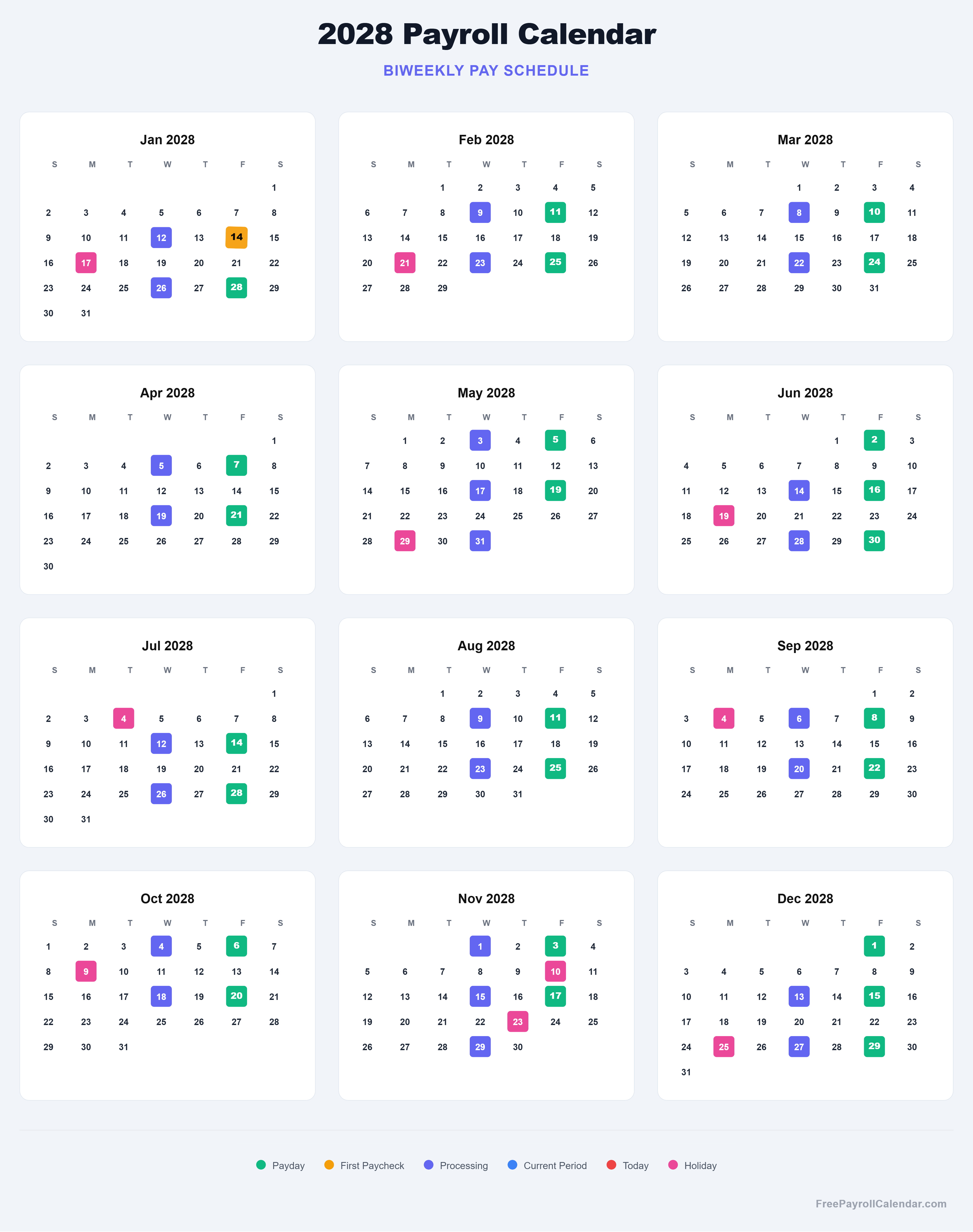
In 2028, employees paid on a standard biweekly schedule will receive 26 paychecks across the calendar year. The pay cycle commences with the first disbursement on Friday, January 14, 2028 (covering the initial earnings period from Sunday, December 26, 2027 through Saturday, January 8, 2028) and concludes on Friday, December 29, 2028. Because 2028 is a leap year featuring 366 days, organizational finance teams, payroll managers, and employees must navigate specific calendar nuances, including how the extra leap day on Tuesday, February 29 impacts hourly shift tracking, timesheet approval deadlines, and banking processing windows.Review historical dates on the 2027 biweekly payroll calendar, or look ahead to next year's schedule on the 2029 biweekly payroll calendar. For teams utilizing fixed twice-per-month disbursements, examine the companion 2028 semi-monthly payroll calendar.
How Many Biweekly Pay Periods Are in 2028?
There are exactly 26 pay periods in the 2028 biweekly payroll schedule. Even though 2028 contains 366 calendar days due to the leap year, the 14-day cadence accounts for 364 days (26 × 14 = 364), leaving a surplus of two calendar days that roll over into subsequent annual cycles. Because the initial payday of 2028 lands on the second Friday of January (January 14), those two surplus days do not trigger a 27th paycheck anomaly in 2028.
For corporate human resource departments and automated enterprise software (such as Workday, ADP, Paychex, Gusto, or QuickBooks Online), this 26-paycheck reality maintains standard compensation calculations. Salaried compensation agreements continue to divide cleanly by 26, voluntary benefit withholdings follow their pre-established schedules, and executive compensation packages remain unencumbered by per-period salary compression adjustments.
The 2028 Leap Year: Impact on Hourly Timecards and Salaried Payroll
A common question among corporate controllers and payroll specialists is whether the February 29 leap day alters annual payroll calculations. The direct impact depends strictly on whether employees are classified as exempt salaried staff or non-exempt hourly wage earners under the Fair Labor Standards Act (FLSA):
- Salaried Employees (Exempt): Annual employment contracts stipulate an established gross wage for the entire 366-day calendar year. Because salaried workers are compensated for delivering on their job duties rather than billing specific hours, their gross pay per pay period remains
Annual Salary ÷ 26. The presence of Tuesday, February 29 does not increase their contractual pay, nor does it require any prorated compensation adjustments. - Hourly Employees (Non-Exempt): Non-exempt employees are legally entitled to compensation for all hours physically worked. Because 2028 has 366 days instead of 365, non-exempt full-time personnel working standard 8-hour Monday-through-Friday schedules will typically work 261 or 262 business days in 2028 (equivalent to 2,088 or 2,096 working hours), compared to the standard 2,080 hours in non-leap years. Employers budgeting for hourly labor must anticipate approximately 8 to 16 additional hours of baseline wage expense per full-time employee across the annual budget.
- Pay Period Spanning Leap Day: In the 2028 biweekly calendar, Pay Period #5 spans from Sunday, February 20 through Saturday, March 4, 2028, with payday falling on Friday, March 10. This specific 14-day window physically contains February 29. Time and attendance systems must be audited in January to guarantee that timesheet software registers February 29 as a legitimate calendar date and applies standard shift differential, meal break deductions, and daily overtime rules correctly.
Which Months Have Three Biweekly Paychecks in 2028?
Because 26 paychecks do not divide evenly across 12 calendar months, every biweekly employee experiences two months each year that contain three paydays rather than the customary two. In 2028, the two "three-paycheck months" are June 2028 and December 2028:
- June 2028: Paychecks land on Friday, June 2, 2028, Friday, June 16, 2028, and Friday, June 30, 2028.
- December 2028: Paychecks land on Friday, December 1, 2028, Friday, December 15, 2028, and Friday, December 29, 2028.
These three-paycheck months are highly anticipated by workers because recurring household obligations—such as residential mortgage payments, apartment leases, auto loans, monthly utility bills, and insurance premiums—are almost universally billed on a once-a-month basis. When workers establish their personal operating budgets around two paychecks per month, the third paycheck arrives with zero obligations toward fixed living costs, functioning as an unencumbered liquidity surge.
Strategic Personal Finance: Maximizing the 2028 Extra Paychecks
Financial advisors recommend developing an intentional strategy for June and December 2028 well before those funds clear into checking accounts. High-yield uses for the third paycheck include:
- Accelerated Debt Elimination: Applying the full net amount of June's third paycheck toward credit card balances or high-interest revolving credit immediately cuts interest accrual before summer travel.
- Emergency Liquidity Reserves: Directing the bonus paycheck into a high-yield savings account helps build or replenish a 3-to-6-month living expense cushion.
- Tax-Advantaged Investment Ceiling: December's third paycheck (December 29) is the ultimate opportunity to maximize annual elective deferrals for your employer-sponsored 401(k), 403(b), or Individual Retirement Account (IRA) before the December 31 annual contribution cutoff.
- Holiday Cash Cushion: Because December's third paycheck arrives on December 29, financial planning around holiday shopping should rely on the early December paychecks (Dec 1 and Dec 15), allowing the December 29 disbursement to fund upcoming January property taxes, semi-annual auto insurance premiums, or new-year savings goals.
Employer Payroll Operations & Benefit "Deduction Holidays"
For enterprise benefits administrators and HR directors, three-paycheck months require operational precision regarding voluntary benefit deductions. Group health insurance, dental insurance, vision plans, flexible spending accounts (FSA), and health savings accounts (HSA) are generally configured on a 24-period deduction schedule across the calendar year (two deductions per month × 12 months).
As a result, on the third paycheck in June (June 30) and the third paycheck in December (December 29), employers implement a benefit deduction holiday. On these two pay dates, premium deductions for medical, dental, and vision insurance are withheld at $0.00. Mandatory statutory withholdings—such as Federal Income Tax (FIT), State Income Tax (SIT), Social Security (6.2%), and Medicare (1.45%)—continue to apply as required by law. Consequently, employees will notice that their net take-home pay on June 30 and December 29 is noticeably higher than on regular paydays.
Federal Reserve Banking Holidays & ACH Cutoff Rules in 2028
Under National Automated Clearing House Association (NACHA) guidelines, direct deposits cannot be finalized or settled on weekends or Federal Reserve banking holidays. When a statutory holiday coincides with a scheduled payday, employers must execute direct deposit originations one business day in advance:
- New Year's Day (Monday, January 3, 2028 observed): January 1, 2028 falls on a Saturday, so federal banks close on Friday, December 31, 2027 or observe on Monday, January 3, 2028. The first biweekly payday of 2028 (January 14) is well clear of this closure.
- Martin Luther King Jr. Day (Monday, January 17, 2028): Banks close on Monday. While the January 14 payday precedes the holiday, payroll files for the following week must be processed with the Monday bank closure in mind.
- Memorial Day (Monday, May 29, 2028): Federal banks close on Monday. Payroll managers running payroll for the June 2, 2028 payday must transmit ACH direct deposit instruction files by Wednesday, May 31 at 5:00 PM EST to guarantee funds settle on Friday morning.
- Juneteenth National Independence Day (Monday, June 19, 2028): Closed. The upcoming June 30 pay run is unaffected.
- Independence Day (Tuesday, July 4, 2028): The holiday falls on Tuesday. ACH files for the Friday, July 14 payday must account for the early week closure.
- Veterans Day (Observed Friday, November 10, 2028): November 11 falls on Saturday, so Federal Reserve banks observe the closure on Friday, November 10. The biweekly payday falling on Friday, November 10 must legally shift to Thursday, November 9, 2028.
- Thanksgiving Day (Thursday, November 23, 2028): Closed nationwide. ACH transmissions must be submitted by Tuesday, November 21 to ensure proper settlement.
- Christmas Day (Monday, December 25, 2028): Banks close on Monday. For the final annual payday on Friday, December 29, ACH originations must be submitted promptly by Wednesday, December 27 following the Monday closure.
Why the Final 2028 Paycheck Lands on December 29
December 31, 2028 lands on a Sunday. Under biweekly payroll rules, disbursements are tethered to specific alternating weekdays (Fridays). Counting 26 sequential 14-day intervals from Friday, January 14 brings Payday #26 to Friday, December 29, 2028.
Under IRS constructive receipt doctrine (Treasury Regulation § 1.451-2), employee earnings are subject to taxation in the calendar year during which the funds are credited to their account or made unconditionally available to them. Because the final paycheck is deposited on December 29, 2028, 100% of these wages, federal withholdings, and FICA taxes will report on the 2028 Form W-2, leaving no straddling tax issues for 2029 tax reporting.
Formulas for Calculating 2028 Biweekly Gross Wages
To compute gross compensation per biweekly paycheck in 2028:
- Salaried Calculations:
Gross Pay Per Period = Stated Annual Salary ÷ 26.- A $65,000 salary yields $2,500.00 gross per biweekly period.
- A $90,000 salary yields $3,461.54 gross per biweekly period.
- A $120,000 salary yields $4,615.38 gross per biweekly period.
- Hourly Calculations:
Gross Pay = Regular Hourly Rate × Regular Hours (up to 80) + (1.5 × Regular Rate × Overtime Hours). Use our dedicated time card calculator and overtime calculator to compute precise split-shift totals.
To model post-tax take-home earnings after statutory deductions, explore our paycheck calculator, or evaluate annual earnings conversions using our salary calculator.
Comprehensive Planning Across Related Pay Frequencies
Multi-entity organizations and enterprise businesses frequently operate blended schedules across corporate staff and frontline hourly teams. Complement your 2028 payroll architecture with our matching guides:
- 2028 Weekly Payroll Calendar — 52 weekly pay dates with shift scheduling support.
- 2028 Semi-Monthly Payroll Calendar — 24 fixed dates on the 15th and end of month.
- 2028 Monthly Payroll Calendar — 12 executive and pension pay dates.
- State Pay Frequency & Wage Laws — Statutory compliance requirements across all 50 states.
- Business Days Calculator — Calculate payroll lag and banking turnaround windows.
- PTO Payout Calculator — Determine accrued vacation payout values for departing personnel.