2028 Weekly Payroll Calendar: Complete 52-Period Schedule & Leap Year Processing Guide
In high-frequency operational sectors such as construction, hospitality, logistics, healthcare staffing, manufacturing, and retail, maintaining an exact payroll schedule is vital to maintaining operational momentum. Under the 2028 weekly payroll calendar, employees receive exactly 52 paychecks. The annual disbursement cycle commences on Friday, January 7, 2028 (covering work performed from December 25 through December 31, 2027 under standard 7-day payroll lag agreements) and concludes on Friday, December 29, 2028.Compare operational workflows with the 2028 biweekly payroll calendar or the corporate 2028 semi-monthly payroll calendar. You can also review how the prior year handled 53 pay periods on our 2027 weekly payroll calendar or plan ahead for 2029 weekly payroll dates.
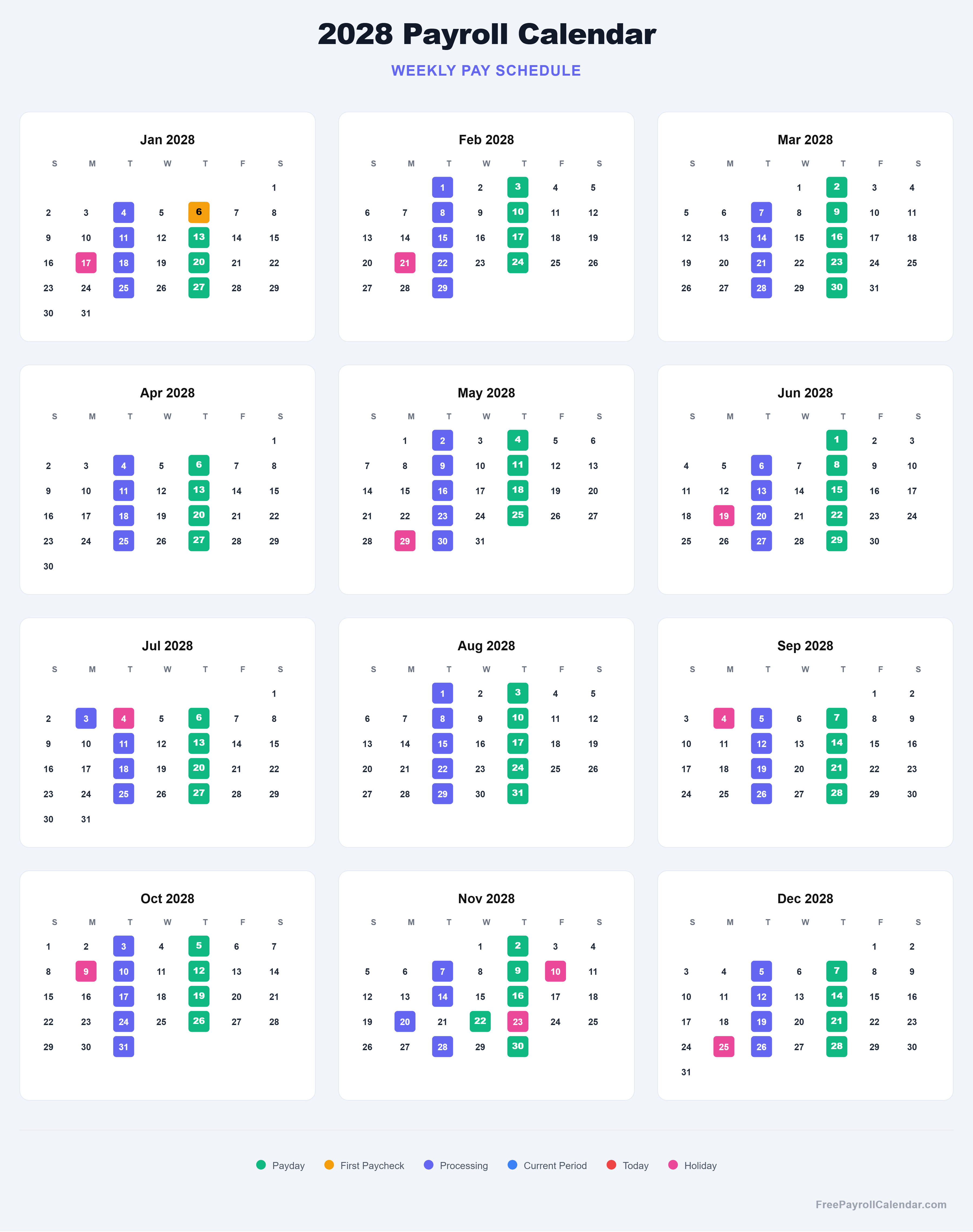
Why 2028 Has Exactly 52 Weekly Paychecks Despite Being a Leap Year
A frequent point of confusion among corporate controllers, accountants, and employees is how a 366-day leap year influences the annual paycheck count. While 2028 is a leap year featuring 366 calendar days, standard Friday-based payroll schedules will execute exactly 52 pay runs.
The mathematical explanation lies in the day of the week on which 2028 begins and ends:
- Leap Year Day Structure: A standard calendar year has 365 days (52 weeks + 1 day). A leap year contains 366 days (52 weeks + 2 days). As a consequence, the two days of the week on which January 1 and January 2 fall will occur 53 times during a leap year, while the remaining five days of the week occur 52 times.
- 2028 Day Alignment: January 1, 2028 falls on a Saturday, and January 2, 2028 falls on a Sunday. Consequently, 2028 contains 53 Saturdays and 53 Sundays, but only 52 Fridays. Because standard weekly payrolls disburse on Fridays, employers will execute precisely 52 weekly payroll cycles during the 2028 calendar year.
The 2027-to-2028 Salary Recalibration Transition
Organizations transitioning from 2027 to 2028 must manage an important compensation reset. Because 2027 was a rare 53-paycheck year, employers who divided annual salaried salaries by 53 (the recalibration method) must revert to dividing by 52 in 2028:
- Salaried Paycheck Restoration: For an employee with an annual salary of $78,000, their 2027 weekly gross paycheck was $1,471.70 ($78,000 ÷ 53). In 2028, their weekly gross paycheck returns to the standard $1,500.00 ($78,000 ÷ 52), representing an increase of $28.30 gross per week.
- Communicating the Change: HR departments should proactively distribute written compensation statements in December 2027 explaining the return to a 52-week divisor. Without clear communication, employees may misinterpret the change as an unplanned raise or become confused regarding their year-end W-2 totals.
Leap Day (Tuesday, February 29, 2028) Payroll Mechanics
The addition of February 29 introduces specific operational requirements that payroll administrators and hourly shift managers must address:
1. Hourly and Non-Exempt Employees
For hourly personnel, February 29 is simply an additional operational workday. All hours worked on Tuesday, February 29, 2028 must be logged on timesheets and compensated in full. Under a standard Sunday-through-Saturday workweek:
- February 29 falls within the workweek of Sunday, February 27 through Saturday, March 4, 2028 (Pay Period #9).
- Earnings for shifts worked on Leap Day are paid on the subsequent Friday payday: Friday, March 10, 2028.
- Overtime worked during that workweek must be paid at 1.5× the regular hourly rate under standard FLSA rules.
2. Salaried Exempt Employees & The FLSA Salary Basis Rule
Under the federal Fair Labor Standards Act (FLSA), 29 CFR § 541.600, exempt executive, administrative, and professional employees must be paid on a "salary basis." This means they receive a predetermined, fixed amount of compensation for each pay period, regardless of the quality or quantity of work performed, or the number of days in the month:
- Salaried employees do not receive extra compensation for working on February 29, 2028.
- In 2028, full-time employees work 262 working weekdays (Monday–Friday) compared to 260 or 261 days in non-leap years, totaling 2,096 standard working hours instead of 2,080. Salaried compensation covers all 2,096 hours without adjustment.
3. Auditing Legacy Payroll & Time-Tracking Software
Before February 2028, IT and payroll administrators must test their automated time-and-attendance systems. Legacy enterprise resource planning (ERP) systems or custom spreadsheets that hardcode February as a 28-day month can fail to capture punches on February 29, leading to off-cycle payroll runs and compliance exposure.
Weekly vs. Biweekly vs. Semi-Monthly: 2028 Operational Matrix
| Operational Attribute | Weekly (52 Checks) | Biweekly (26 Checks) | Semi-Monthly (24 Checks) |
|---|---|---|---|
| Disbursements in 2028 | 52 Paychecks | 26 Paychecks | 24 Paychecks |
| $70,000 Annual Gross / Check | $1,346.15 gross | $2,692.31 gross | $2,916.67 gross |
| FLSA Overtime Tracking | 100% Direct Match (7-day workweek) | Two 7-day cycles per period | Split workweeks require proration |
| ACH & Software Processing Cost | Highest (52 submissions/year) | Moderate (26 submissions/year) | Lowest (24 submissions/year) |
| Workforce Fit | Manual labor, retail, hourly trades | Healthcare, technology, mixed staff | Corporate executives, salaried staff |
FLSA Overtime Compliance: The 7-Day Workweek Advantage
Under Section 7(a) of the Fair Labor Standards Act (FLSA), 29 U.S.C. § 207(a), covered non-exempt employees must receive overtime compensation at a rate not less than one and one-half times their regular rate of pay for all hours worked in excess of 40 hours during a workweek.
The statutory workweek is defined as a fixed and regularly recurring period of 168 hours—seven consecutive 24-hour periods. Weekly payroll provides an unmatched compliance advantage because each pay period correlates exactly with one statutory workweek:
- No Split-Week Proration: In semi-monthly pay systems, the 15th of the month frequently lands in the middle of a workweek (e.g., on a Wednesday), splitting a 7-day workweek across two separate paychecks and creating significant mathematical errors in calculating whether the 40-hour overtime threshold was crossed.
- Immediate Correction of Discrepancies: With weekly pay, timecard disputes, missed punch reconciliations, and meal break penalties are resolved within days, preventing minor discrepancies from festering into large-scale wage-and-hour lawsuits.
State Wage Payment Mandates: Why Weekly Pay is Legally Required
While multi-state corporations often seek to streamline all business entities onto biweekly or semi-monthly payrolls, state wage payment statutes strictly regulate minimum payment frequencies:
- New York Labor Law § 191(1)(a): Mandates that "manual workers" (defined expansively by the New York State Department of Labor to include mechanics, warehouse workers, truck drivers, line technicians, and janitorial personnel) must be paid weekly, no later than seven calendar days after the end of the week in which wages were earned. New York courts (such as Vega v. CM & Associates Construction Management LLC) have established that paying manual workers biweekly constitutes a violation of § 191, entitling workers to statutory liquidated damages.
- Massachusetts General Laws ch. 149, § 148: Directs that hourly employees must be compensated weekly (or biweekly within 6 to 7 days of period close), with severe treble-damage penalties for delayed wage distributions.
- Connecticut General Statutes § 31-71b: Mandates weekly wage payments on an established regular payday unless granted an explicit regulatory exemption.
Four Months with 5 Weekly Paychecks in 2028
In 2028, four months feature five Friday paydays:
- March 2028: 5 Paychecks (Mar 3, Mar 10, Mar 17, Mar 24, Mar 31).
- June 2028: 5 Paychecks (Jun 2, Jun 9, Jun 16, Jun 23, Jun 30).
- September 2028: 5 Paychecks (Sep 1, Sep 8, Sep 15, Sep 22, Sep 29).
- December 2028: 5 Paychecks (Dec 1, Dec 8, Dec 15, Dec 22, Dec 29).
For hourly employees living paycheck to paycheck, these four 5-paycheck months provide a vital financial cushion. Because monthly recurring fixed expenses (such as rent, automobile financing, and student loans) are typically budgeted across four paychecks, the fifth weekly paycheck can be allocated entirely toward savings, debt elimination, or emergency reserves.
2028 Federal Reserve Bank Holidays & ACH Transmission Deadlines
Because weekly payroll runs 52 times across 2028, payroll administrators must align their processing timetables with Federal Reserve banking closures to ensure timely direct deposit settlement under NACHA rules:
- New Year's Day (Observed Monday, January 3, 2028): January 1 falls on Saturday. The first weekly payday of the year (Friday, January 7) requires ACH batch submission by Tuesday, January 4.
- Martin Luther King Jr. Day (Monday, January 17, 2028): Banks closed. Transmit payroll files for the Friday, January 21 payday by Tuesday, January 18.
- Presidents' Day / Washington's Birthday (Monday, February 21, 2028): Banks closed. Submit files for the February 25 payday by Tuesday, February 22.
- Memorial Day (Monday, May 29, 2028): Federal Reserve closed. Timesheets for the June 2 payday must be approved and transmitted by Tuesday, May 30.
- Juneteenth National Independence Day (Monday, June 19, 2028): Federal Reserve closed. Transmit direct deposit files for Friday, June 23 by Tuesday, June 20.
- Independence Day (Tuesday, July 4, 2028): Banks closed. Files for the Friday, July 7 payday must be submitted by Monday, July 3.
- Labor Day (Monday, September 4, 2028): Banks closed. Transmit payroll files for Friday, September 8 by Tuesday, September 5.
- Columbus Day / Indigenous Peoples' Day (Monday, October 9, 2028): Federal Reserve closed. Submit files for October 13 payday by Tuesday, October 10.
- Veterans Day (Observed Monday, November 13, 2028): November 11 falls on Saturday; banks observe Monday, November 13. Transmit files for Friday, November 17 by Tuesday, November 14.
- Thanksgiving Day (Thursday, November 23, 2028): Banks closed nationwide. Direct deposit batches for Friday, November 24 must be submitted no later than Tuesday, November 21 at 5:00 PM EST.
- Christmas Day (Monday, December 25, 2028): Federal Reserve closed. Transmit payroll files for the final annual payday (Friday, December 29) by Tuesday, December 26.