2027 Monthly Payroll Calendar
Monthly-paid employees see exactly 12 paychecks in 2027 - no exceptions, no bonus months, just one deposit per calendar month. The year opens with Friday, January 29, 2027 (covering the full month of January) and closes with Friday, December 31, 2027, a clean end-of-year finish since December 31 lands on a business day.Need to reference last year? Review the monthly payroll calendar 2026. Planning ahead? Check out the monthly pay schedule 2028. Looking for more frequent pay dates? Check out the semi-monthly pay schedule 2027.
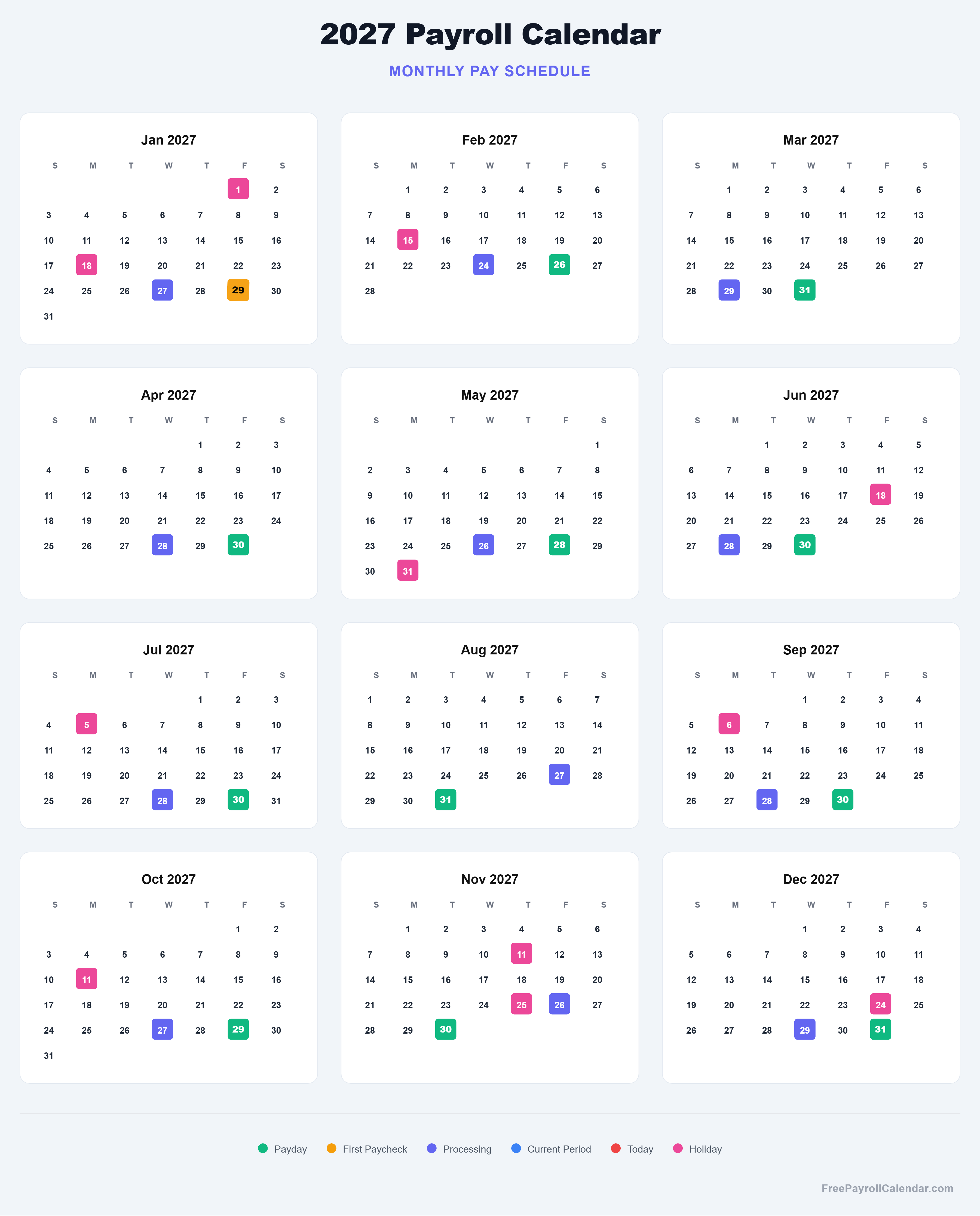
Why January's paycheck lands on the 29th, not the 31st: January 31, 2027 falls on a Sunday, and banks don't process direct deposits over the weekend. Payroll shifts the deposit to the closest preceding business day - which pushes it back two days to Friday, January 29. This two-business-day gap (rather than the usual one-day shift) happens specifically because the month ends on a Sunday, not a Saturday; a Sunday month-end always costs monthly-paid employees a slightly bigger jump backward than a Saturday one would.
Monthly vs. biweekly: the budgeting gap
The core difference isn't just paycheck frequency - it's cash-flow rhythm. Biweekly employees get a check every two weeks, meaning even a bad month is only ever two weeks from resolution. Monthly employees are managing a 30-day runway on a single deposit, which means one unexpected expense early in the month has to be absorbed by that same paycheck rather than smoothed out by another one arriving soon after.
Monthly pay and the "one bad week" problem
The single biggest financial planning challenge with monthly pay is that any unexpected expense in the first half of the month has to be absorbed by the same paycheck that also has to last another two to three weeks. There's no second check arriving mid-month to smooth things out, unlike biweekly or semi-monthly schedules. Employees on monthly pay who don't already have some kind of cash buffer are the most exposed to a single bad week derailing their entire month's budget - making it highly worthwhile to build toward even a modest buffer if you're on this schedule and don't have one yet.
Why some employers still prefer monthly
From a pure administrative-cost standpoint, monthly payroll is the cheapest schedule to run: 12 processing cycles a year instead of 24, 26, or 52 means fewer bank transaction fees, less time spent per cycle on tax withholding calculations, and simpler year-end reconciliation. This is why the schedule persists in academia, government, and some executive compensation structures, even though it shifts more budgeting burden onto the employee than any other frequency.