2027 Semi-Monthly Payroll Calendar
Semi-monthly employees always get exactly 24 paychecks a year, regardless of how the calendar falls. In 2027, that cycle opens with Friday, January 15, 2027 (covering January 1-15) and closes with Monday, January 3, 2028 for the final December period, delayed slightly by the New Year's holiday.Need to reference last year? Review the semi monthly payroll calendar 2026. Planning ahead? Check out the semi monthly pay schedule 2028. For the most common US pay cycle, see the biweekly pay schedule 2027.
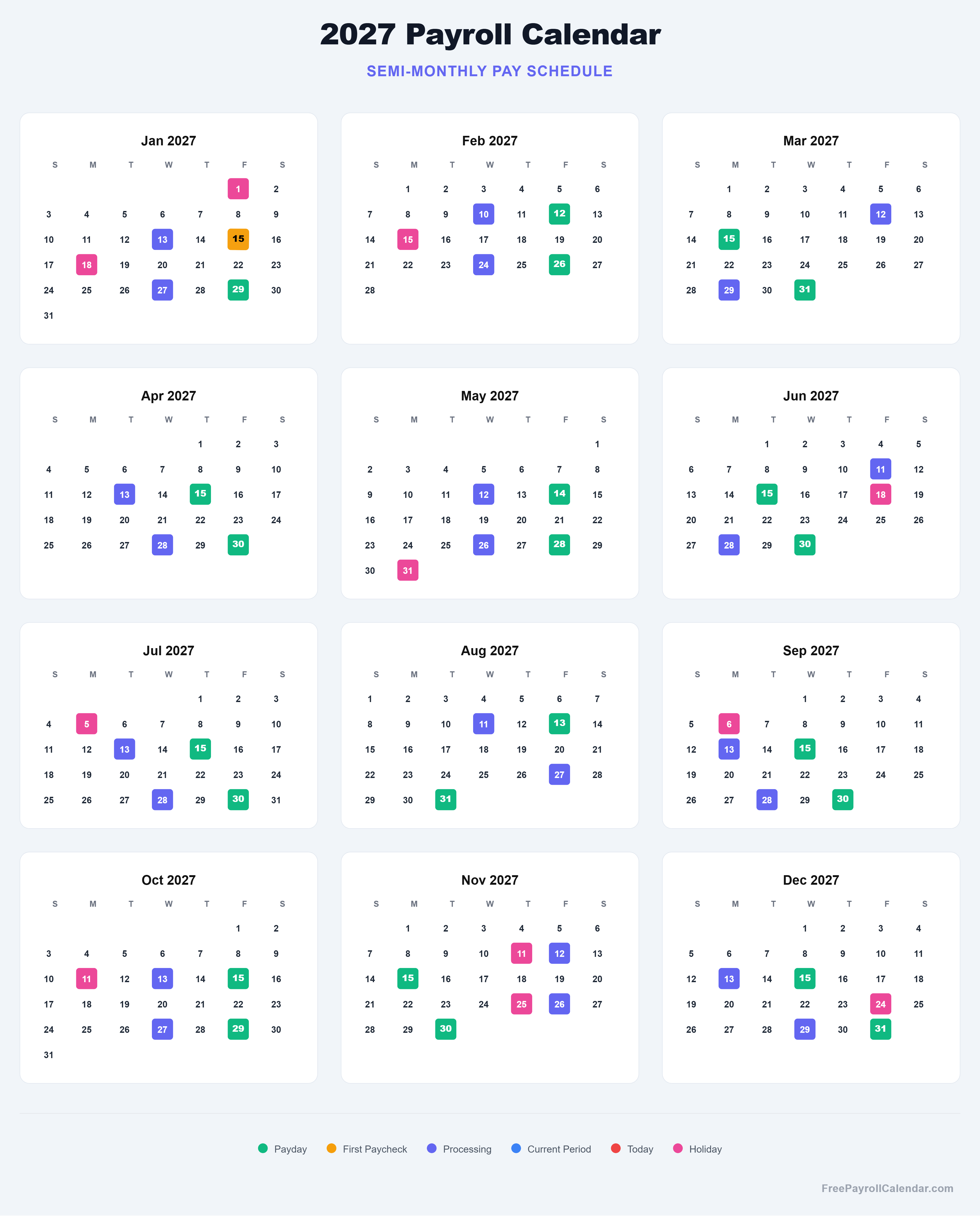
Why the last paycheck of 2027 arrives in January 2028
The second half of December (16th-31st) is typically paid on the following month's first payday - normally January 1. But January 1, 2028 is a Saturday, and it's also New Year's Day, a federal holiday. With both a weekend and a holiday stacked together, payroll processing shifts the deposit further out, landing on Monday, January 3, 2028 rather than the very next business day. This is a good example of why semi-monthly schedules occasionally need a full extra business day of buffer beyond the usual "shift to Friday" rule.
Fixed dates, shifting weekdays - the core semi-monthly quirk
If you're used to a biweekly job, semi-monthly pay can feel unpredictable at first because the payday isn't tied to a specific weekday. In 2027, the 15th of the month falls on a Friday in January, but it won't fall on a Friday again for months at a time, as it moves depending on how the calendar shifts. This is exactly why keeping a full-year semi-monthly calendar on hand (rather than mentally tracking "the 15th and the last day") avoids missed expectations around payday.
Semi-monthly and benefit deductions
One underrated advantage of semi-monthly pay, especially for HR teams, is that benefit deductions (health insurance, retirement contributions) divide evenly across exactly 24 paychecks with no remainder - unlike biweekly's 26 or 27, which sometimes require special handling in a three-paycheck month to avoid double-deducting.