2026 Biweekly Payroll Calendar
Biweekly is the most common pay frequency in the US private sector, and 2026 delivers a fairly clean version of it: 26 paychecks, with the first landing on Friday, January 2, 2026 (covering the period December 14–27, 2025) and the last on Friday, December 18, 2026.Need to reference last year? Review the biweekly payroll calendar 2025. Planning ahead? Check out the biweekly pay schedule 2027. If your organization uses a twice-a-month cycle instead, explore the semi-monthly payroll calendar 2026.
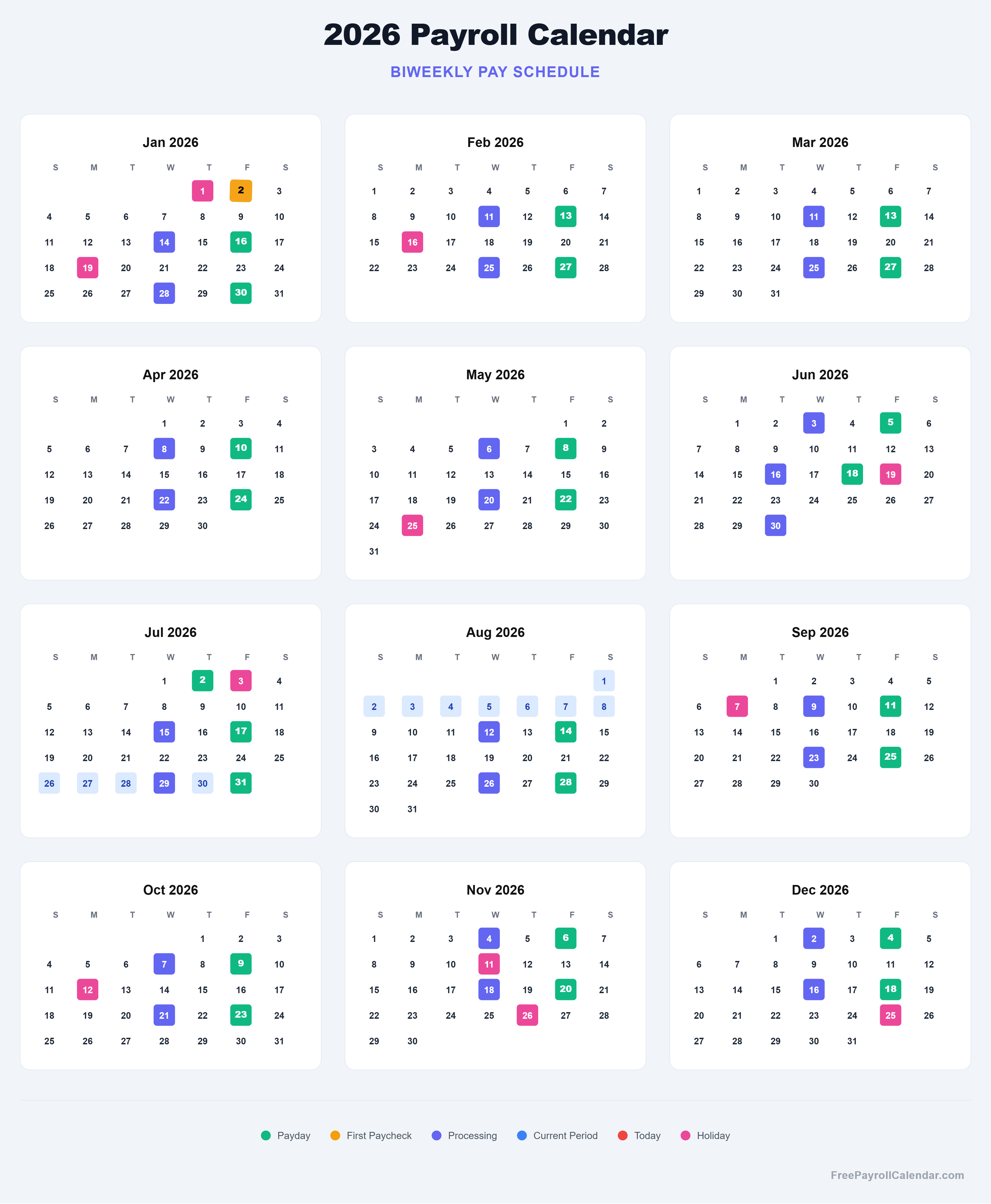
Notice the gap - the year ends on December 18 rather than a date closer to December 31. That's normal for a biweekly cycle: because 26 periods of 14 days only add up to 364 days, the "extra" day each year gradually pushes the final payday earlier relative to the calendar. It doesn't mean employees are shorted a pay period; the next check simply falls in early January 2027.
The two three-paycheck months in 2026
Because most calendar months run slightly longer than four weeks, biweekly employees see two months a year where three paydays land instead of two. In 2026, those months are January and July. If you're budgeting ahead, mark these on your calendar - that third check is a good opportunity to get ahead on savings, debt payoff, or a lump-sum bill, rather than treating it as extra spending money that quietly disappears.
For employers, the same two months mean an extra payroll run to fund and process - worth flagging to finance/cash-flow planning early rather than discovering it the week of.
How Benefits Deductions Work in 3-Paycheck Months (January & July 2026)
One common point of confusion for biweekly employees during 3-paycheck months like January and July 2026 is why their net take-home pay might look larger on the third payday. Most corporate health insurance premiums, dental plans, FSA contributions, and fixed voluntary benefits are calculated on a 24-paycheck schedule (dividing annual costs equally across two checks per month).
As a result, on the third payday of January 2026 (January 30) and July 2026 (July 31), no health or dental insurance premiums are deducted from your pay stub. Statutory tax withholdings (Federal Income Tax, Social Security, and Medicare) still apply as usual, but your take-home pay will be noticeably higher. Check with your HR administrator or pay stub breakdown to confirm whether your company uses a 24-period or 26-period deduction schedule.
Federal Bank Holiday Deadlines & ACH Direct Deposit Shifts for 2026
The Automated Clearing House (ACH) network does not process direct deposit settlements on federal banking holidays or weekends. To ensure employees receive direct deposits on time, payroll managers must submit ACH files at least two business days prior to bank closures. In 2026, keep these specific holiday shifts on your radar:
- Juneteenth (Friday, June 19, 2026): Federal banks close. Employers on a Friday pay schedule must submit payroll by Tuesday, June 16 to guarantee deposit clearance on Thursday, June 18.
- Independence Day (Observed Friday, July 3, 2026): Since July 4 falls on a Saturday, banks observe the holiday on Friday, July 3. Payday moves to Thursday, July 2, 2026.
- Thanksgiving (Thursday, November 26, 2026): Timesheets for the pay period ending right before Thanksgiving must be approved early so processing completes by Tuesday afternoon.
- Christmas Day (Friday, December 25, 2026): Direct deposits for the final pay period of 2026 will settle on Thursday, December 24, 2026.
Building a "2-Paycheck Baseline" Budget for 2026
Financial planners frequently recommend the "2-paycheck baseline" budgeting framework for biweekly wage earners. Under this strategy, you build your core monthly budget—housing payments, debt obligations, utilities, groceries, and insurance—assuming you only receive two paychecks per month (totaling 24 paychecks a year).
When the two "magic paychecks" land in January 2026 and July 2026, the entire income from those third checks is unencumbered by recurring monthly bills. You can allocate 100% of those funds toward high-priority financial goals, such as maxing out a Roth IRA, funding a holiday travel fund, or lump-sum paying down high-interest credit card debt.
Calculating Hourly vs. Salaried Biweekly Paychecks in 2026
For salaried employees earning an annual compensation package, your biweekly gross salary is calculated by dividing your annual base pay by 26 pay periods. For example, an annual salary of $65,000 yields $2,500.00 gross per paycheck ($65,000 / 26).
For non-exempt hourly employees, biweekly gross pay equals your hourly rate multiplied by the total hours worked across each standard 14-day work cycle (typically 80 hours for a full-time schedule). Under Fair Labor Standards Act (FLSA) regulations, overtime must be evaluated per single 7-day workweek (hours over 40 in week 1 or week 2), not averaged over the full 14-day biweekly pay period.
How biweekly differs from semi-monthly in practice
The confusion between biweekly and semi-monthly is one of the most common payroll questions, and it comes down to this: biweekly always lands on the same weekday (Friday, in this case), while semi-monthly locks to specific calendar dates (like the 15th and last day) and drifts across weekdays instead. Biweekly gives 26 checks a year; semi-monthly gives exactly 24. If your pay stub shows a different amount depending on the month, semi-monthly is the more likely culprit - biweekly paychecks are the same size every time (absent overtime).
Printable 2026 Payroll Calendar
To prevent administrative delays, plan for holiday bank closures. For example, during Independence Day weeks, submit files early. Print this page or download a 2026 biweekly payroll calendar pdf for reference.