2027 Weekly Payroll Calendar: Complete 53-Period Schedule & Salary Recalibration Guide
For corporate controllers, HR compensation managers, and weekly-paid personnel, 2027 presents a critical calendar milestone: it is a rare 53-paycheck payroll year. While typical operating years produce exactly 52 weekly disbursements, the 2027 weekly payroll calendar delivers 53 distinct Friday pay dates. The annual cycle opens early on Thursday, December 31, 2026 (accelerated by one business day because Friday, January 1, 2027 is New Year's Day, an official Federal Reserve holiday) and culminates with the 53rd disbursement on Friday, December 31, 2027.Compare operational workflows with the 2027 biweekly payroll calendar or the executive 2027 semi-monthly payroll calendar. You can also review standard 52-week cycles on our 2026 weekly payroll calendar or anticipate the leap year schedule on the 2028 weekly payroll calendar.
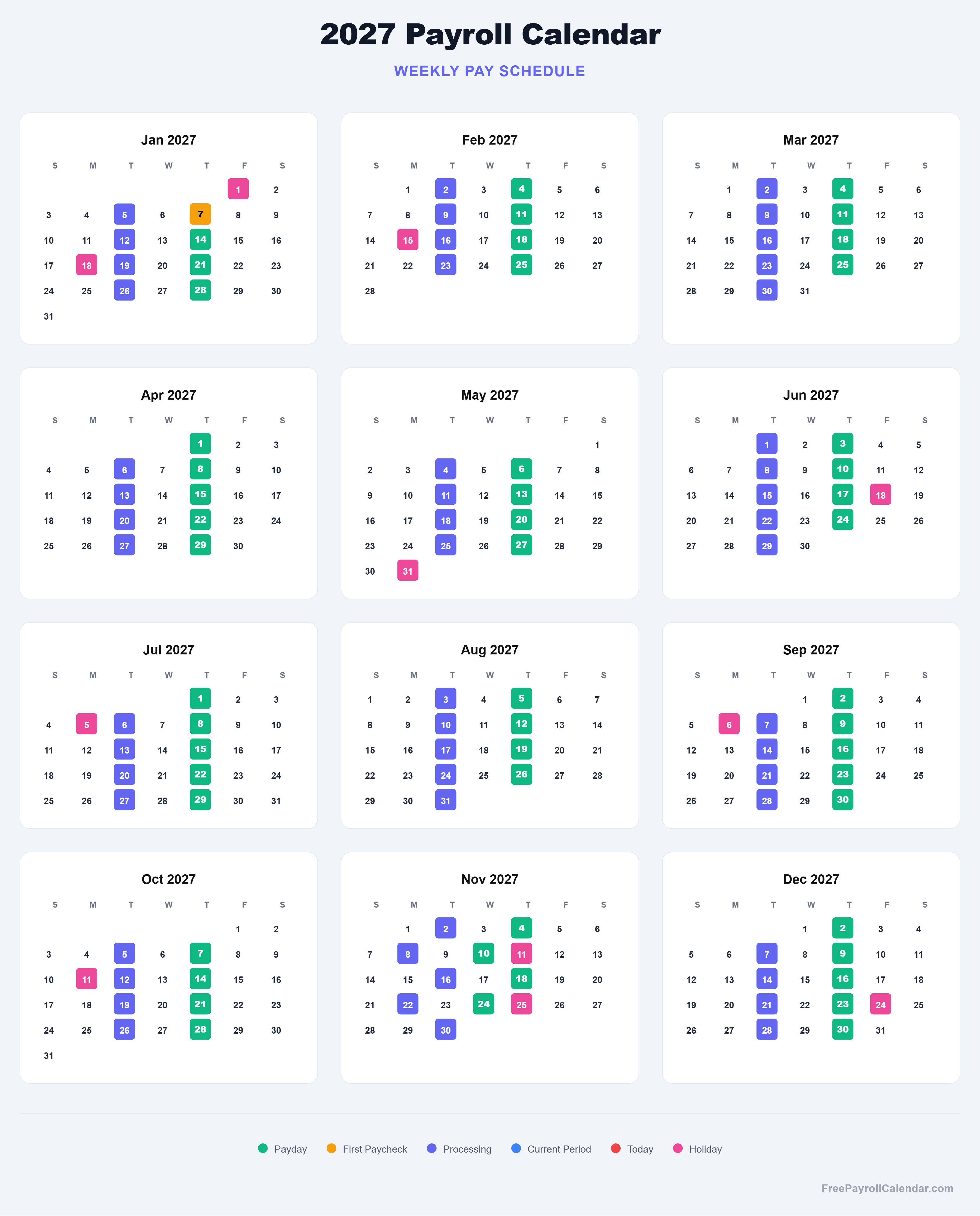
The Calendar Mathematics Behind 53 Pay Periods in 2027
Why does 2027 generate 53 weekly paychecks instead of 52? The anomaly arises from fundamental calendar arithmetic:
- The 364 vs. 365-Day Gap: A standard 52-week payroll year accounts for 364 calendar days (52 weeks × 7 days = 364 days). However, a standard Gregorian calendar year encompasses 365 days (and 366 days in a leap year).
- Surplus Day Accumulation: Every standard year leaves 1 residual day (2 days in leap years). Because of this remainder, whichever day of the week the calendar year begins on will occur 53 times rather than 52.
- The 2027 Friday Alignment: In 2027, January 1 falls on a Friday, and December 31 also falls on a Friday. Consequently, 2027 contains exactly 53 Fridays. Because the vast majority of weekly payroll disbursements are scheduled on Fridays, organizations running weekly pay will inevitably encounter 53 disbursements within the 2027 tax reporting year.
Employer Decision Framework: Handling Salaried Staff in a 53-Paycheck Year
For non-exempt hourly employees, a 53-paycheck year is seamless: employees log their hours, submit weekly timesheets, and receive compensation for the exact hours worked. However, for salaried exempt staff whose compensation is stated as an annual figure (e.g., $78,000 per year), employers face a strategic compensation dilemma. Corporate finance and HR leadership must select one of two primary administrative methods:
Method 1: The "True 53rd Paycheck" (Divide by 52)
Under this approach, the employer maintains the standard weekly divisor of 52. An employee earning $78,000 annually receives $1,500.00 gross per weekly paycheck ($78,000 ÷ 52). On the 53rd payday (December 31, 2027), the employee receives an additional full paycheck of $1,500.00, elevating their total gross W-2 earnings for 2027 to $79,500.00:
- Advantages: Maximizes employee morale, prevents any reduction in weekly cash flow, and eliminates confusion regarding weekly take-home pay.
- Financial Cost: Expands annual salaried payroll expenses by approximately 1.92% (1 ÷ 52). CFOs and controllers must budget for this extra wage expense in their Q4 2026 planning cycles.
Method 2: The "Salary Recalibration" (Divide by 53)
Under this approach, the employer divides the contracted annual salary by 53 rather than 52. An employee earning $78,000 annually receives $1,471.70 gross per weekly check ($78,000 ÷ 53). Over 53 pay periods, the employee receives exactly $78,000.10, matching their contracted annual salary:
- Advantages: Keeps corporate compensation budgets 100% on target without unbudgeted payroll inflation.
- Operational Challenges: Decreases weekly take-home pay by roughly 1.89%, which can trigger employee dissatisfaction if not communicated clearly months in advance. Furthermore, employment offer letters that specify an explicit weekly salary rate (rather than an annualized amount) may legally constrain employers from reducing weekly pay without written consent.
Employee Benefit Deductions & The "Deduction Holiday"
One of the most consequential administrative nuances of a 53-paycheck year is the treatment of payroll benefit deductions. Employer-sponsored benefits generally fall into two categories: fixed dollar deductions and percentage-based deductions.
| Deduction Category | Deduction Mechanism | Treatment on Paycheck #53 | Action Required |
|---|---|---|---|
| Health, Dental & Vision Insurance | Fixed Annual Premium ÷ 52 | Deduction Holiday (Zero Withheld) | Suppress deduction on check #53 to avoid over-collecting employee premiums. |
| Flexible Spending Account (FSA) | Annual Election ÷ 52 | Deduction Holiday (Zero Withheld) | Withholding on check #53 would exceed the IRS statutory annual FSA limit. |
| 401(k) / 403(b) Retirement Deferrals | Percentage of Gross Earnings (%) | Deducted Normally | Calculate percentage on gross wages unless the employee has reached annual statutory caps. |
| FICA (Social Security & Medicare) | Mandatory Federal Tax (%) | Deducted Normally | Apply 6.2% Social Security (up to wage base) and 1.45% Medicare to all taxable earnings. |
| Life & Disability Insurance | Fixed Monthly / Annual Fee | Deduction Holiday | Ensure insurer receives 12 monthly payments without excess employee withholding. |
401(k) Contribution Caps & The Year-End Employer Match Risk
In a 53-paycheck year, retirement plan administrators must monitor elective deferrals with heightened vigilance. If an employee elects a flat dollar contribution per weekly check (for example, $450 per week), contributing across 53 pay periods may cause them to reach the IRS annual deferral limit several weeks early (e.g., during Paycheck #51 in mid-December).
If deferrals cease automatically in mid-December, employees whose companies calculate matching contributions on a per-paycheck basis may forfeit employer match dollars on Paychecks #52 and #53. To protect participants, plan sponsors should verify whether their 401(k) plan contains a "True-Up Match" provision, which reconciles annual contributions and guarantees that employees receive the full match promised by the employer.
Five Months with 5 Weekly Paychecks in 2027
While a typical year features four months with 5 weekly paydays, 2027 contains five separate 5-paycheck months:
- January 2027: 5 Paychecks (Dec 31, 2026 [adv. from Jan 1], Jan 8, Jan 15, Jan 22, Jan 29).
- April 2027: 5 Paychecks (Apr 2, Apr 9, Apr 16, Apr 23, Apr 30).
- July 2027: 5 Paychecks (Jul 2, Jul 9, Jul 16, Jul 23, Jul 30).
- October 2027: 5 Paychecks (Oct 1, Oct 8, Oct 15, Oct 22, Oct 29).
- December 2027: 5 Paychecks (Dec 3, Dec 10, Dec 17, Dec 24, Dec 31).
For hourly employees budgeting their living expenses against monthly rent and mortgage obligations, these five months yield substantial surplus cash flow, as monthly housing payments are covered by the first 4 paychecks, leaving the 5th check unencumbered by recurring fixed bills.
Weekly vs. Biweekly vs. Semi-Monthly: 2027 Comparison
| Key Metric | Weekly Schedule (2027) | Biweekly Schedule (2027) | Semi-Monthly Schedule (2027) |
|---|---|---|---|
| Total Paychecks in 2027 | 53 Paychecks (Anomaly Year) | 26 Paychecks (Standard) | 24 Paychecks (Standard) |
| $75,000 Gross / Check (True Check) | $1,442.31 gross (53 checks = $76,442) | $2,884.62 gross | $3,125.00 gross |
| $75,000 Gross / Check (Recalibrated) | $1,415.09 gross (53 checks = $75,000) | $2,884.62 gross | $3,125.00 gross |
| FLSA Workweek Overtime Match | 100% Direct Match (No split weeks) | Two 7-day cycles per period | Split workweeks require complex proration |
| Payroll Processing Workload | 53 runs / year (Highest ACH costs) | 26 runs / year | 24 runs / year (Lowest ACH costs) |
FLSA Overtime Compliance & Zero Split-Workweek Risk
The Fair Labor Standards Act (FLSA), 29 U.S.C. § 207, dictates that overtime must be evaluated across an established, regularly recurring workweek consisting of seven consecutive 24-hour periods (168 consecutive hours). Non-exempt employees who exceed 40 hours during that defined period must receive overtime pay at no less than 1.5 times their regular rate.
Weekly payroll remains the gold standard for FLSA compliance because the pay period is mathematically identical to the statutory workweek. Semi-monthly payrolls, by contrast, frequently split 7-day workweeks across consecutive calendar months, forcing payroll administrators to perform complex payroll adjustments and estimate trailing overtime. With weekly payroll, overtime is calculated, reviewed, and finalized immediately upon period close.
State Wage Mandates: New York Labor Law § 191 & Manual Workers
While many corporations prefer biweekly or semi-monthly cadences to reduce administrative overhead, state labor legislation frequently prohibits less frequent payments for blue-collar or hourly workforces:
- New York Labor Law § 191(1)(a): Mandates that manual workers must be paid weekly, no later than seven calendar days after the end of the workweek in which the wages were earned. Employers who pay manual workers biweekly—even with employee agreement—are liable for liquidated damages equal to 100% of delayed wages under prominent New York court precedents.
- Massachusetts General Laws ch. 149, § 148: Directs that non-exempt hourly employees must be compensated within 6 to 7 days of the close of the pay period, strongly incentivizing weekly payroll runs.
- Connecticut General Statutes § 31-71b: Establishes weekly payroll as the default statutory frequency for non-exempt personnel.
2027 Federal Reserve Bank Holidays & ACH File Processing Cutoffs
Because weekly payroll requires 53 submissions in 2027, payroll departments must plan around Federal Reserve closures to guarantee timely direct deposit settlement under NACHA rules:
- New Year's Day (Friday, January 1, 2027): Federal Reserve closed. Payday #1 moves to Thursday, December 31, 2026. ACH batch transmission deadline: Tuesday, December 29, 2026 by 5:00 PM EST.
- Martin Luther King Jr. Day (Monday, January 18, 2027): Banks closed. Submit files for the Friday, January 22 payday by Tuesday, January 19.
- Presidents' Day / Washington's Birthday (Monday, February 15, 2027): Banks closed. Transmit payroll files for the February 19 payday by Tuesday, February 16.
- Memorial Day (Monday, May 31, 2027): Federal Reserve closed. Submit files for the Friday, June 4 payday by Tuesday, June 1.
- Juneteenth National Independence Day (Observed Friday, June 18, 2027): June 19 falls on Saturday; Federal Reserve observes on Friday, June 18. Payday advances to Thursday, June 17, 2027. ACH files must be transmitted by Tuesday, June 15.
- Independence Day (Observed Monday, July 5, 2027): July 4 falls on Sunday; Federal Reserve observes Monday, July 5. Payday for Friday, July 2 is unaffected, but timesheet cutoffs for the July 9 check must advance to Tuesday, July 6.
- Labor Day (Monday, September 6, 2027): Banks closed. Submit files for the September 10 payday by Tuesday, September 7.
- Columbus Day / Indigenous Peoples' Day (Monday, October 11, 2027): Federal Reserve closed. Submit files for October 15 payday by Tuesday, October 12.
- Veterans Day (Thursday, November 11, 2027): Commercial banks closed. Files for the Friday, November 12 payday must be originated by Monday, November 8.
- Thanksgiving Day (Thursday, November 25, 2027): Banks closed nationwide. Direct deposit files for Friday, November 26 must be finalized and submitted by Tuesday, November 23.
- Christmas Day (Observed Friday, December 24, 2027): December 25 falls on Saturday; Federal Reserve observes on Friday, December 24. Paycheck #52 advances to Thursday, December 23, 2027. ACH batch must be submitted by Tuesday, December 21.
- Paycheck #53 (Friday, December 31, 2027): New Year's Eve is an open Federal Reserve banking day. Paycheck #53 clears on Friday, December 31, 2027. Transmit files by Wednesday, December 29.