2025 Weekly Payroll Calendar
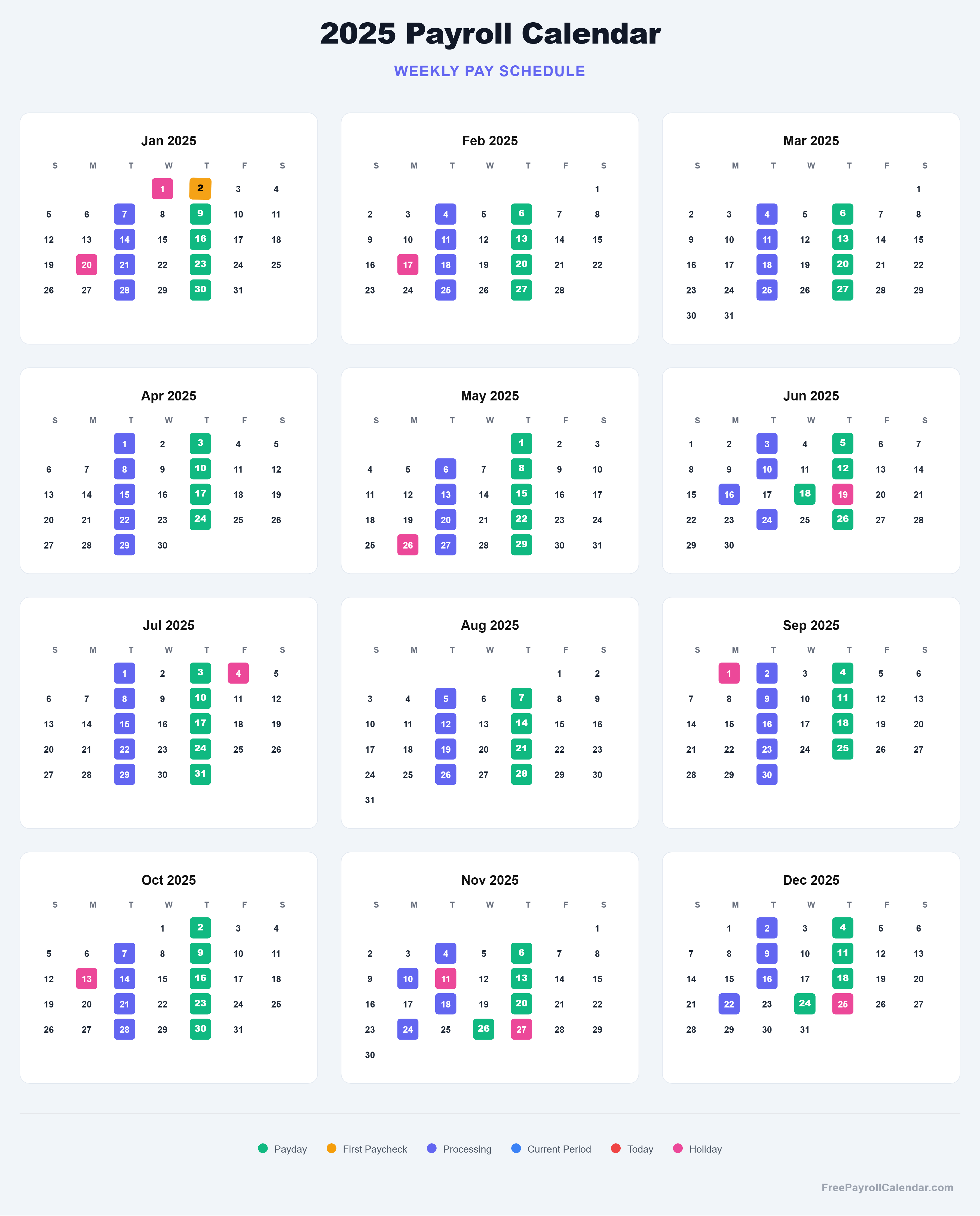
Implementing a weekly payment cycle helps businesses maintain a steady flow of labor, but it demands rigorous administrative coordination. Under the 2025 weekly payroll calendar, employers run payroll exactly 52 times. The very first paycheck of the year is issued on Friday, January 3, 2025, covering hours worked from Dec 21, 2024 through Dec 27, 2024. The year's final payment clears on Friday, December 26, 2025.Planning ahead? Check out the weekly pay schedule 2026. If your company pays less frequently, you can also view the biweekly payroll calendar 2025.
Managing the 52-Paycheck Cycle
Operating on a weekly schedule means timesheets, auditing, and ACH transfers must be executed every single week without fail. This creates an extremely fast-paced environment for HR and accounting departments. In 2025, establishing an airtight routine is paramount. A typical flow involves employees submitting timesheets on Friday or Saturday, managers approving them by Monday morning, and payroll processing the ACH file by Wednesday afternoon to ensure funds clear into employee bank accounts by Friday morning. Missing a deadline by even a few hours can result in delayed direct deposits and significant employee dissatisfaction.
The Five-Paycheck Months in 2025
Because a calendar month spans more than four weeks (except non-leap year Februaries), a weekly pay schedule guarantees that four months out of every year will contain five paydays instead of the usual four. In 2025, employees paid every Friday will receive five paychecks in January, May, August, and October.
For workers budgeting on a monthly basis, these five-paycheck months offer a vital financial cushion, providing an extra week of income to cover unforeseen expenses, build emergency savings, or pay down debts. From an operational standpoint, businesses must ensure they have sufficient liquidity to cover a 25% increase in labor costs during these specific months. Accurately forecasting cash flow around these 2025 anomalies is a critical component of successful financial management for any weekly-paying enterprise.
Impact of 2025 Federal Holidays on Processing
Federal bank holidays pose the biggest threat to a smooth weekly payroll cycle. When the Federal Reserve is closed, ACH transactions cannot be processed. In 2025, holidays such as New Year's Day (Wednesday, Jan 1), Juneteenth (Thursday, June 19), and Christmas Day (Thursday, Dec 25) will directly intersect with standard weekly processing days.
For example, because Christmas 2025 falls on a Thursday, companies that normally process their payroll files on Thursday morning for a Friday payday will be forced to move their entire workflow up by 24 to 48 hours. Employers must communicate these accelerated deadlines clearly to staff well in advance to ensure timesheets are submitted early, preventing any disruptions to the holiday pay schedule.
Compliance and State Regulations
While weekly payroll demands the highest administrative overhead, many businesses do not have a choice. Various states have enacted strict labor laws dictating pay frequency based on the type of work performed. For instance, in states like New York and Massachusetts, manual workers must be paid on a weekly basis, not later than seven calendar days after the end of the week in which the wages were earned. Ensuring strict adherence to these regulations across the entire 2025 calendar year is absolutely necessary to avoid severe fines and wage claim lawsuits.
Evaluating Weekly vs. Less Frequent Cycles
The decision to adopt a weekly pay schedule in 2025 often comes down to workforce retention and industry norms. In high-turnover sectors such as construction, hospitality, manufacturing, and retail, paying employees weekly is a powerful recruitment and retention tool. Workers in these industries often prefer or require immediate access to their earned wages to manage personal cash flow. However, unlike longer cycles that space out administrative tasks, the weekly model requires dedicated software and efficient personnel. If a company lacks an automated time-tracking and processing system, the sheer volume of 52 cycles can easily overwhelm a small back-office team.